

Buying an Ice Hut: A Checklist for Northern Ontario Anglers
When someone asks me about buying an ice hut, I start with one question: do you want a rigid hut you tow out for the season, or a portable shelter you can pack up and carry? In this guide I walk through Ontario's registration rules, size and packed weight, the Clam X-400 I point people to, and the anchors, light, and heat safety that go with it.
TL;DR
- Ontario registration and removal rules
- Hard-sided hut or soft shelter
- Fishable area and packed weight
- The Clam X-400 hub shelter
- Anchors, light, and heat safety
- The checklist for the counter
- Trying the shelter in Sault Ste. Marie
Who this article is for
- First-time buyers choosing their first ice hut
- Anglers who walk in and need a shelter they can carry
- Anglers unsure whether their hut needs registering in their zone
- Two-person crews comparing shelter sizes and packed weights
Mario Gionet
Sales
A note from the author
Ice huts are the purchase I see people rush the most, because the brochure photo looks so good. I wrote this one around the order I would check things in myself: the province's rules first, then whether you can actually carry the thing, then everything that keeps it standing on the ice. I come at it as a camper and paddler, so the carry matters a lot to me. I would rather you leave with a checklist than with a model name.
Ontario's Registration Rules Depend on Your Zone and Your Hut's Size
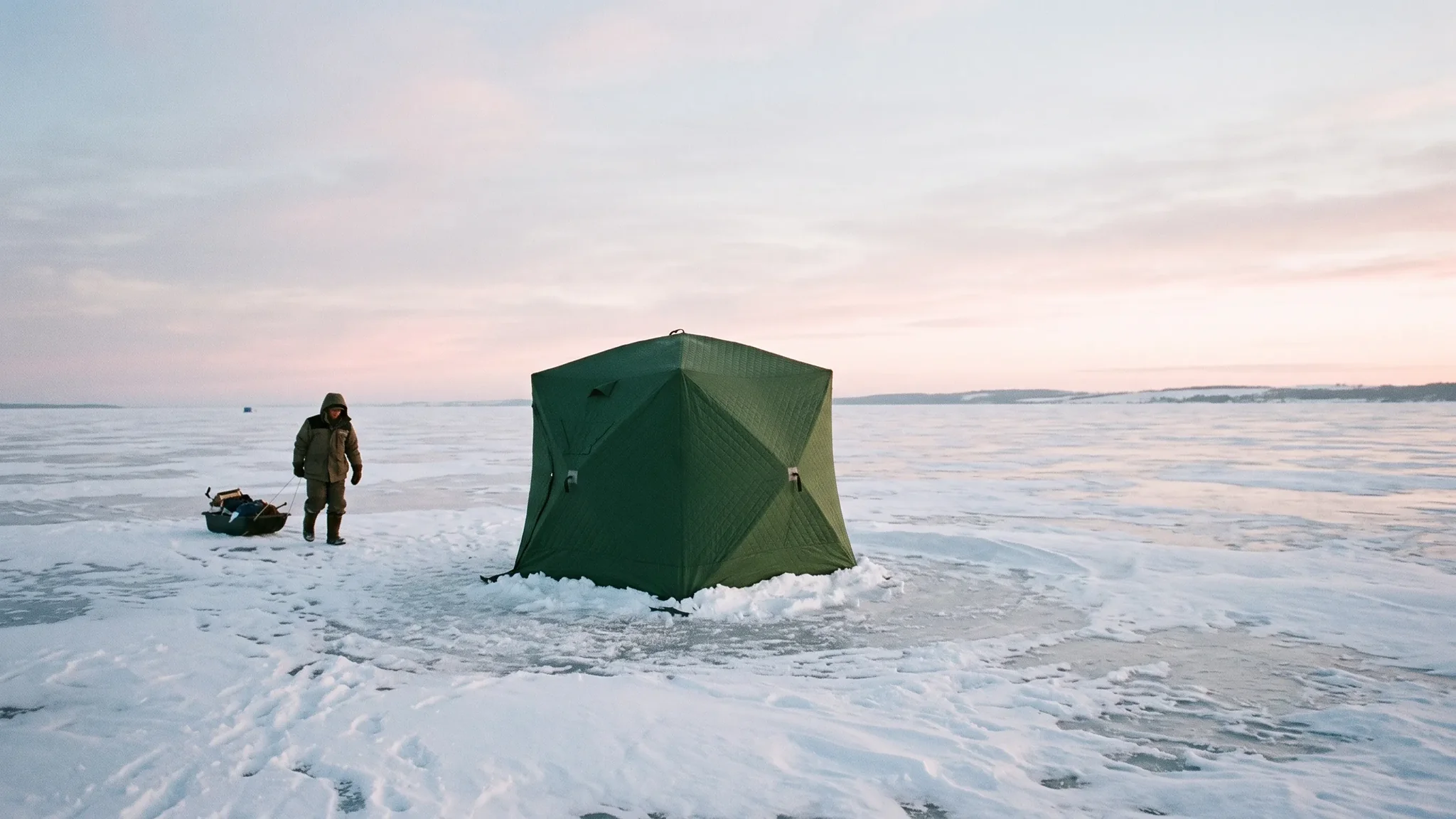
Every December a customer walks in and asks me the same thing: "Do I need to register this hut?" I used to answer from memory, so now I send people to the source before they spend a dollar. The Government of Ontario's ice fishing page is the provincial guidance for anglers, and it is the place to read the current rules for ice huts. It says you must register an ice hut used in Fisheries Management Zones (FMZs) 9 to 12 and 14 to 20 if it is made of any material other than fabric, or if it is a fabric tent covering 7 square metres (75.4 square feet) or more when erected. Huts in FMZs 1 to 8 and 13 do not need registering, and neither do fabric tents covering 7 square metres or less.
Registration is free, and the page says you do not need an Outdoors Card. You can register online through the Fish and Wildlife Licensing Service or in person at a participating ServiceOntario location. A registered hut shows its number on the outside, at least 6.3 centimetres (2.5 inches) high.
The same page sets removal dates by zone: March 1 for FMZ 17 and 20, March 15 for FMZ 14, 16, 18, 19, and part of FMZ 12, and March 31 for FMZ 9, 10, 11, 15, and the rest of FMZ 12. It adds that all ice huts must be removed before ice breakup, even if no removal date applies. Those dates are why a hut you can tow or carry off the lake in one trip beats one you have to plan a crew around. My advice: check your zone first, because it decides whether a hard-sided hut means paperwork and a fixed pull-out date.

Hard-Sided or Soft Shelter: Pick the One You Can Carry
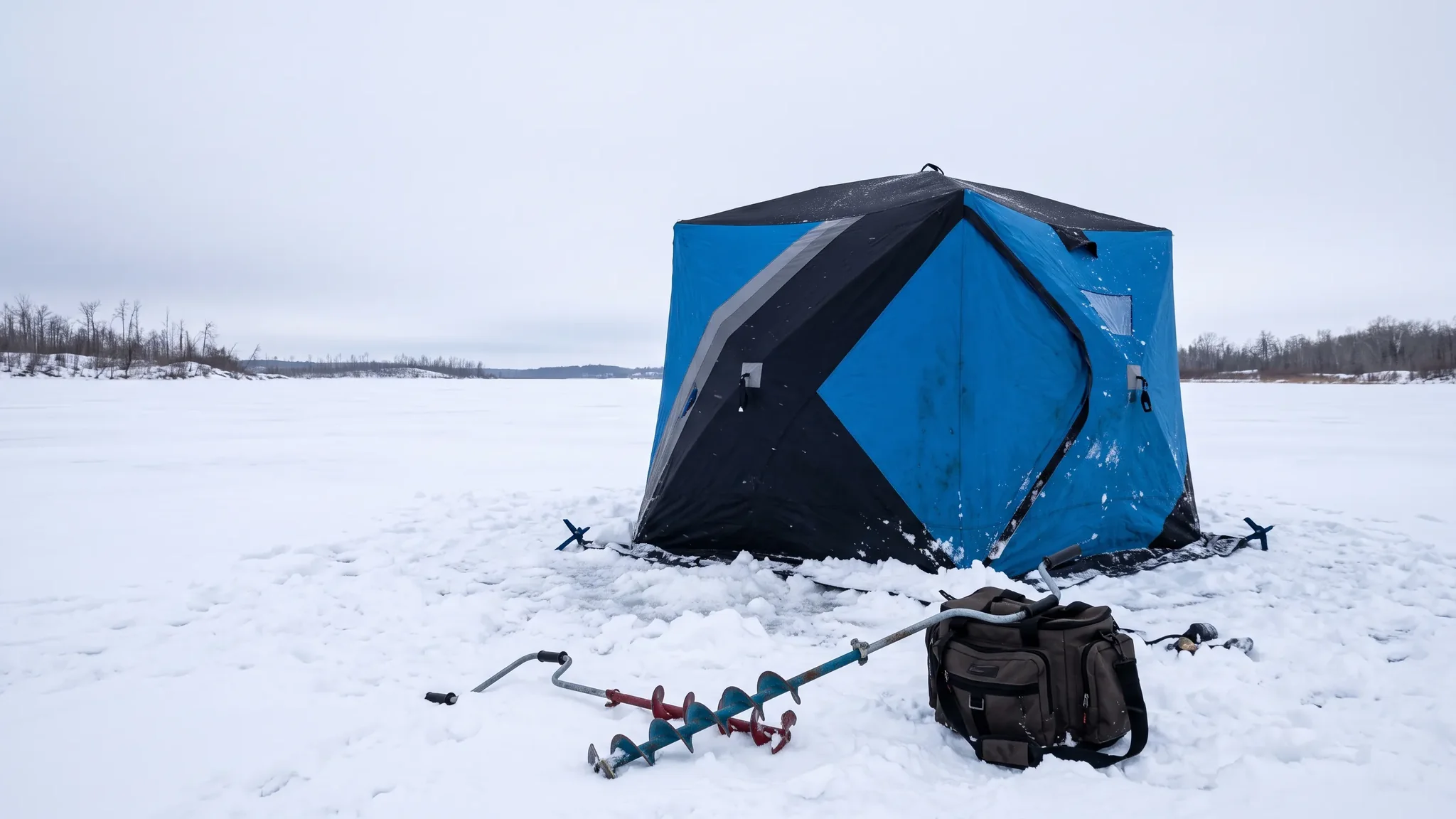
Most first-time buyers are choosing between two designs. A hard-sided hut is a rigid box, often built on a sled, that you tow out and leave standing for the season. A soft shelter is a fabric tent on a frame, built to be packed into a bag and set up wherever you stop. A portable hub shelter is the soft kind, and it's the one I point most Northern Ontario anglers to first, because most of them are walking in or loading a truck, not towing a bunkie.
The hard-sided design suits an angler who fishes the same bay all winter and has a way to tow it. The soft shelter suits the angler who moves between lakes, walks in from a plowed lot, or has to fit the whole kit into a car or truck. A fabric hut also leaves you out of the registration rule above, as long as it stays under the size limit the province sets.
Think about the carry before you think about the colour. I have camped and canoed long enough to know that gear you dread hauling is gear that stays home, and an unused shelter was the wrong purchase at any price. My best trip was taking my beagle out on his first canoe trip.

Measure the Fishable Area and the Packed Weight, Not Just the Brochure Photo
Every shelter page lists a capacity, and the number that matters is the floor you can fish from. Two anglers with rods, a bucket, a rod locker, and a heater need more room than a spec line suggests. Work through three numbers on the shelter's page.
- Setup size: The footprint on the ice and the wall height. Taller walls mean you can stand up to change a layer.
- Fishable area: The open floor where the holes go. More holes need more floor.
- Pack size and weight: What you carry or tow, and what has to fit in your vehicle.
Then add the people, which is the step I see skipped most when someone shops from the brochure photo. A shelter listed for four anglers fits four comfortably only when each of them has a hole and a seat, and every extra bucket, rod case, and heater takes a share of the floor. If you fish alone most days and bring one friend, a smaller shelter is lighter to carry, and the extra square footage of a bigger one is room you would be hauling around for nothing.

The Clam X-400 Is the Hub Shelter I Point to for Three to Four Anglers
The Clam X-400 Thermal Ice Shelter Hub ($899.95) is the one ice hut on the shelf right now, and it's the one I walk people through when they want a roomy portable. Here is what the product page says about it.
- It is a four-sided hub shelter with 64 square feet of fishable area, and it sets up at 8 ft x 8 ft with a centre height of 82 inches and a wall height of 69 inches.
- Clam says it fits 3 to 4 anglers comfortably.
- Thermal Trap Technology is designed to retain heat and reduce condensation, and the fabric is 900 total denier with 90 g/sq m of insulation.
- The Max Entry door lets you bank snow against the shelter and still use the door. There are two doors on opposite sides, each 38 inches wide, and an oversized skirt for snow banking.
- It uses 11 mm flex-tested poles with lab-tested hub assemblies.
- Eight ice anchors and an oversized carry bag with a cinch strap come with it, and Clam backs it with a 3 year warranty.
The packed size is 64 x 12 x 12 inches, and it weighs 50 lb. That is the number I ask people to be honest with themselves about. A 50 lb bag is fine behind a sled or on a truck bed, and it is a real carry if you walk in. If you fish with a partner and share the load, the extra room is worth it.
It is made of fabric and sets up at 64 square feet, which is under the province's 7 square metre (75.4 square feet) line for fabric tents. Check the Ontario page above for the zone you fish before you rely on that, since the rules differ across the zones.
Every shelter on the shelf is listed under Huts and Shelters, and the rest of the ice fishing range sits one click away.

Anchors, Drill Adapters, and Other Add-Ons That Keep a Hut in Place
A fabric shelter is a sail on a flat frozen lake. The anchors are what keep it on your hole instead of across the bay, so treat them as part of the hut price, not an afterthought.
Ice anchors
The X-400 comes with eight, and you only need more if you want a spare set or a second shelter. The Eskimo Ice Anchors ($34.95 for a 2 pack) are self-tapping with sharp points that make them easy to start before you screw them the rest of the way in, and large handles you can grip and twist with gloves on.
Setting anchors with a drill
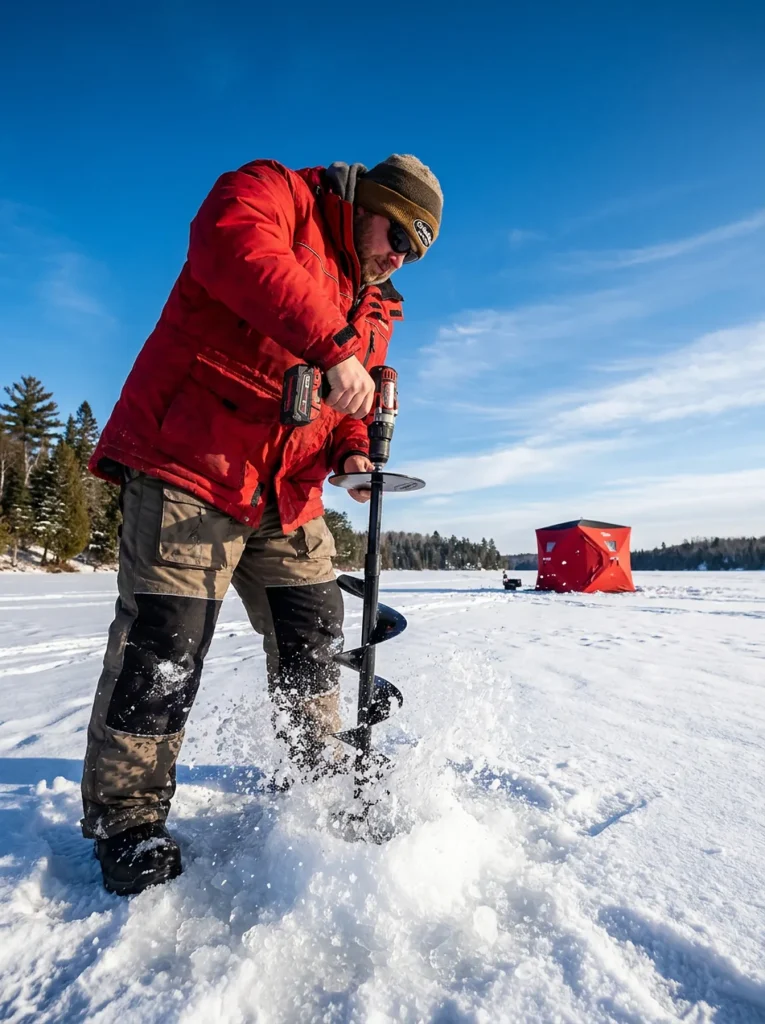
Turning eight anchors by hand gets old fast. The Eskimo Universal Ice Anchor Drill Adapter ($29.95) attaches to a cordless drill, holds the anchor, and drives it in when you pull the trigger. Eskimo says its holder accepts competitor anchors too, and that the adapter also works for reeling up tip-ups.
If you already run a drill auger, the Eskimo Quick Connect Kit ($74.95) does the same job. Its included Anchor Install Adapter lets a cordless drill or E40 powerhead drive in shelter anchors, and the kit swaps auger bits without tools. It comes in two versions, so check which auger you run before you order. The auger guide, linked in the checklist below, covers that decision in detail.
Clearing slush and carrying rods
Inside the hut, slush builds up in the hole faster than you expect. The Rapala Mega Scoop ($31.95) has a 34 in handle so you can clear a hole standing up, a fold-in basket for storage, and a 30 in ruler. A rod bag such as the Rapala Ice Combo Locker ($54.95, large, 36 to 42 inches) keeps your ice rods together on the walk in. It has an inside pocket for extra spools of line and terminal tackle.
Light, Heat, and Safety Inside the Hut Need a Plan of Their Own
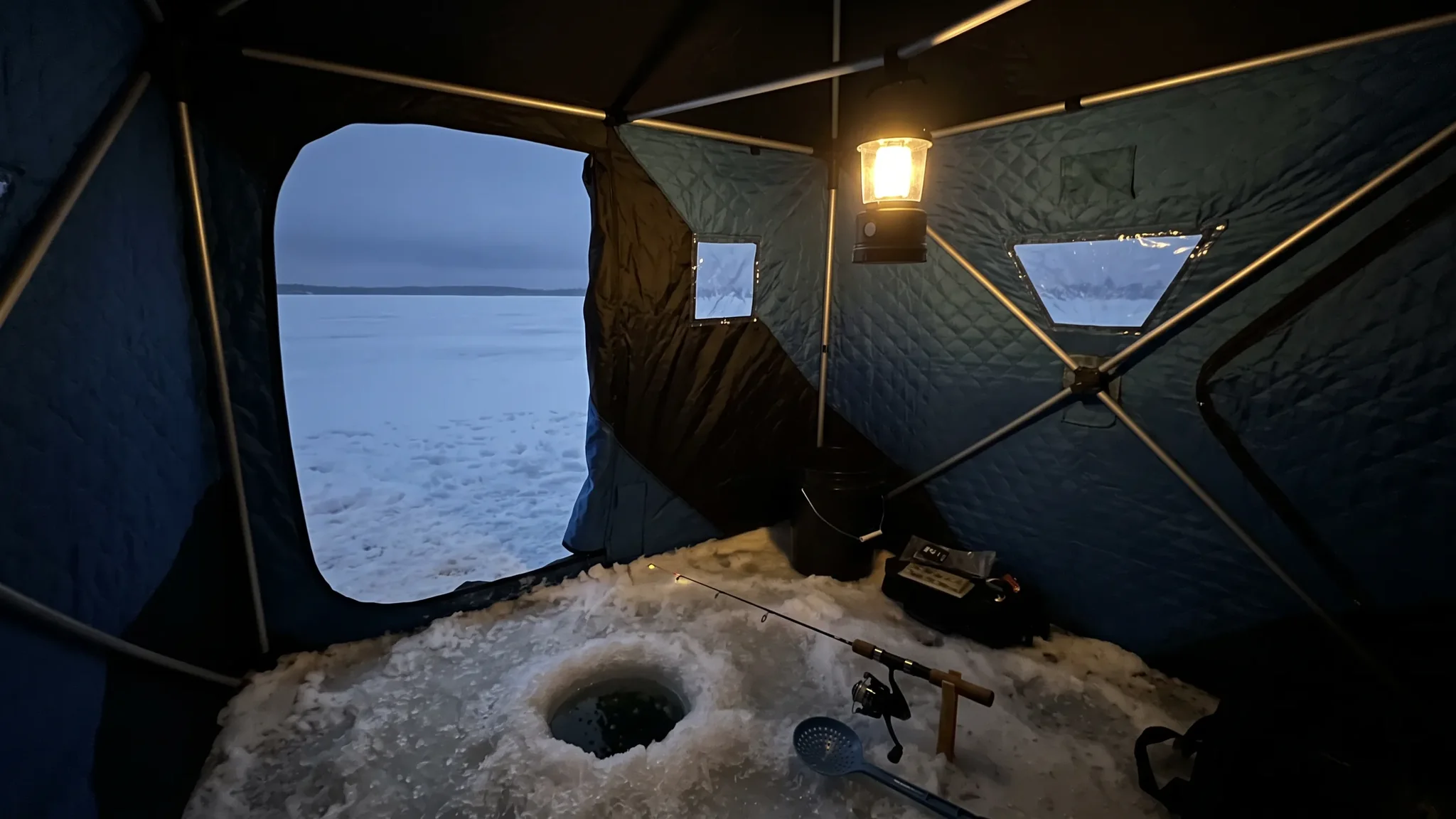
A shelter makes the cold easier to manage, but it also puts you in a small closed space with your gear, so plan the light and the heat deliberately.
Light
A battery lantern is the simplest light for a hut, and it brings no flame into the fabric. The NEBO Big Poppy Lantern RC ($64.95) has a 300 lumen lantern mode rated at 3 hours, a 120 lumen spotlight, and a flickering flame mode that NEBO says gives a realistic flame without heat or fire danger. It is rechargeable and can charge other USB devices, so top it up before you leave home and bring a spare power source on long days.
Heat
I don't have an ice hut heater to recommend by name right now, so I will stick to what the province says. That comes from the Ontario government's carbon monoxide safety page, which lists portable fuel-burning heaters among the appliances that produce carbon monoxide and says to vent all portable fuel-burning heaters properly, according to the manufacturer's instructions. Read the heater's manual for how it is meant to be used in a tent, and ask the maker if the manual doesn't say.
A way out of the water
Walking out to a hut means trusting the ice. The Ontario ice fishing page gives its own figures for vehicles only: snowmobiles need at least 20 centimetres (8 inches) of clear blue ice, and light vehicles need 30 centimetres (12 inches) or more. It does not give a walking figure, so drill a test hole and measure as you go. A pair of ice claws such as the Rapala Steel Spike Ice Claws ($17.49) is a compact pocket item with hardened steel spikes, an adjustable lanyard, and a body that floats.
The Checklist to Run Through at the Counter
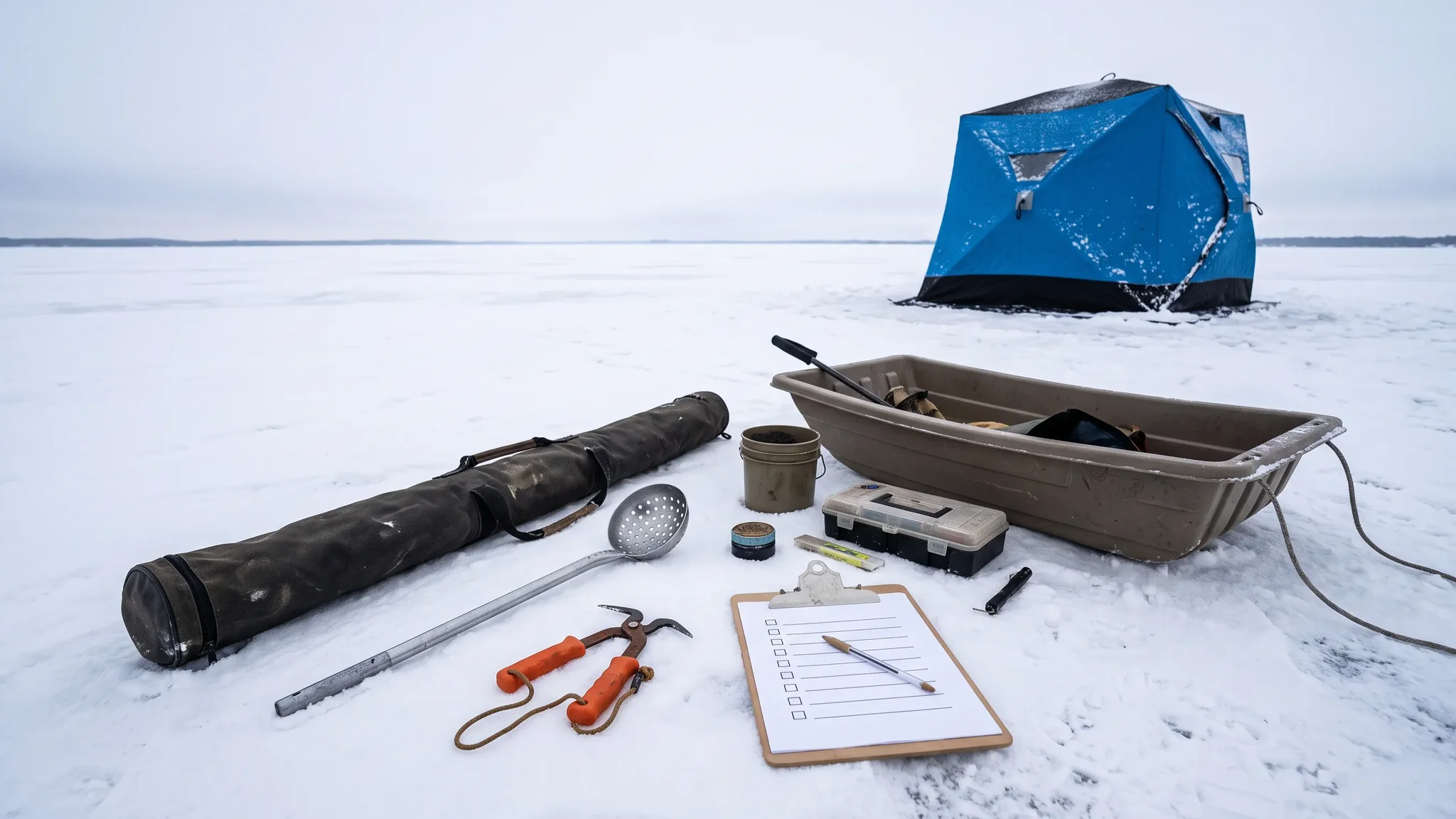
Take this list with you to the store, or run through it on the shelter's page. If you can answer yes to each line, the hut is the right one.
- Do I know which FMZ I fish, and what that zone says about registration and the removal date?
- Does the shelter's fishable area fit the number of anglers who actually come with me?
- Can I carry or tow the packed weight and size on a normal day, not just a good one?
- Are anchors included, and do I have a plan to drive them in with a drill?
- Is there a lantern, and a way to charge it?
- If I plan to use a heater, have I read its manual for use inside a tent?
- Do I have a rod bag, a scoop, and a pair of ice claws?
- Have I planned the rest of the kit? The auger guide along with the guide to ice fishing rods cover the two biggest pieces.
If most answers are yes and one is a no, that's the line to fix first, and it's often a small purchase. If several are no, the shelter is probably not the right place to start spending.
Questions
Hard-sided hut or soft shelter?
In my experience, choose a hard-sided hut if you fish one spot all season and can tow it. Choose a soft shelter if you move between lakes, walk in, or have to fit everything in a vehicle. A fabric tent covering under 7 square metres also avoids the province's registration rule, though you should check the zone you fish.
How much does a portable hut weigh when packed?
It depends on the model, so read the product page, and I always tell people to look at this number first. The Clam X-400 I point people to packs to 64 x 12 x 12 inches and weighs 50 lb. A sled makes that easy over flat ice, and it is a real carry if you walk in, so think about how far you go from the truck.
What heater is safe inside a hut?
I don't have an ice hut heater to recommend by name right now, so I stick to what the province says. Ontario's carbon monoxide page says to vent portable fuel-burning heaters properly, according to the manufacturer's instructions. Read the heater's manual for how it may be used in a tent, and ask the maker if the manual doesn't say.
Come Try the Shelter Before You Buy It
The easiest way to choose a hut is with the pack size and weight in front of you. Stop by Great Lakes Outfitters in Sault Ste. Marie, tell me how many anglers you fish with, and I will help you match the shelter to the crew.
Talk to us about it
- 162 Old Garden River Rd, Sault Ste. Marie, ON P6B 5A6
- (705) 253-2361
- Open today 10 a.m. to 6 p.m.
- Send us a message
References
About the author
Mario Gionet
Sales
I work in sales at Great Lakes Outfitters. I have been here four years, and before that I was in school.
More from Mario Gionet
 English (Canada)
 Français du Canada