

Ice Fishing Gear: The Complete Guide for Northern Ontario
Putting together an ice fishing kit for Northern Ontario starts with one question: what do you need on the ice before you worry about the fun parts? We'll walk you through ice safety first, then the tent, auger, rods, line, and tip-ups, and finally three kits at three budgets built from the gear we sell.
TL;DR
- Ice safety and what a complete kit contains
- Choosing a tent size and style
- Auger, rods, and ice line
- Tip-ups for watching more than one hole
- Clothing, small items, and the order to buy in
- Three kits at three budgets
- Where to see the gear in Sault Ste. Marie
Who this article is for
- First-time ice anglers building a kit from scratch
- Anglers replacing a worn-out tent, auger, or rod
- Families and groups planning a shared shelter
- Budget-minded buyers who want the arithmetic shown
Steve Meating
Owner
A note from the author
We wrote this guide around the ice fishing gear we sell at 162 Old Garden River Road, so every product named in it is one you can buy from us. Prices are as they were on our store the day this went up. If you have questions about a tent, an auger, or a kit, call us or come in and we will help you sort it out.
Ice Safety Comes Before Any Piece of Ice Fishing Gear
Every ice fishing gear list should start with the ice itself, because no ice fishing tent, auger, or rod is worth anything if the surface under it will not hold. The Government of Ontario's ice fishing page is the province's own summary of the rules and safety tips for anglers on the ice. It reminds anglers that ice doesn't freeze at a uniform thickness, that near-shore ice is often much thicker and safer than ice farther out (especially early in the season), and that thickness should be checked regularly with a spud bar or an auger as you move away from shore.
The Lifesaving Society is the Ontario branch of the Royal Life Saving Society Canada, a registered charity that trains swimmers and lifeguards and works on drowning prevention. Its cold water and ice page lists 4 inches (10 cm) as the minimum ice thickness for a single person, 5 inches (12 cm) for a snowmobile or ATV, and 8 to 12 inches (20 to 30 cm) for a single car. It also warns that "no ice is safe ice," and that the quality and thickness of ice can change very quickly and look misleading.
Here is how those two sources shape the way we think about a first-ice gear list:
- Measure before you commit. A drill-driven or powered auger doubles as a thickness gauge, and an ice chisel lets you test the surface ahead of each step.
- Read the colour. Ontario says clear blue ice is the strongest, white or opaque ice is much weaker, and honeycombed ice should be avoided, which is common during thaws and in spring.
- Respect moving water. Ice that formed over flowing water, springs, pressure cracks, old ice holes, or around the mouths of rivers and streams can be weaker than the ice around it.
- Never go alone, and tell someone your plan. The Lifesaving Society notes that half of ice-related fatalities occurred when the person was alone, and both sources ask you to share where you are going and when you expect to be back.
Around Sault Ste. Marie, with the St. Marys River running past town and Lake Superior and the North Channel close by, current and changing water levels are part of everyday winter angling. We would rather you read this section twice than skip it, because the rest of this guide assumes you have already decided the ice is safe to be on.
Ice Picks, a Rope, and a Flotation Layer Are Gear Too
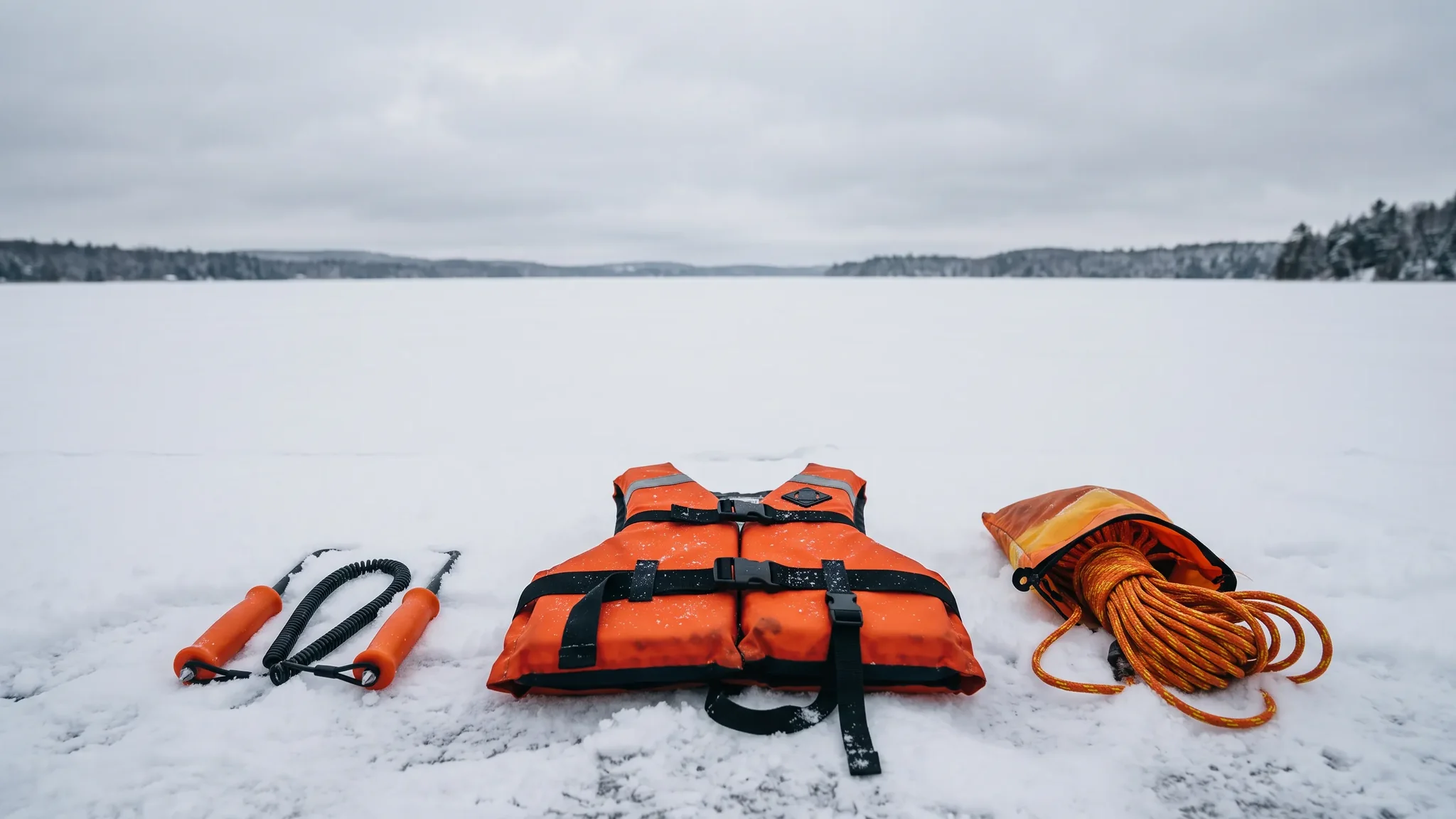
The Lifesaving Society tells anyone going out on the ice to wear a thermal protection buoyant suit if they have one, and otherwise to wear a brightly coloured lifejacket or PFD over an ordinary snowmobile suit or layered winter clothing. It also suggests carrying ice picks, an ice staff, a rope, and a cellular phone, plus a small personal safety kit that includes a lighter, waterproof matches, a pocketknife, a compass, and a whistle.
The Rapala Steel Spike Ice Claws ($17.49) are our entry-level answer to the ice picks line on that list. They have hardened steel spikes in a lightweight, rigid, co-molded body, they come with an adjustable lanyard, and they float. Wear them on a lanyard where you can reach them with either hand, because the Lifesaving Society's advice for a fall through the ice is to turn toward the direction you came from, place your arms on the unbroken ice, and kick your way out on your stomach, which is a lot easier with a grip in each hand.
The Society also describes a "1-10-1" rule for cold water: You have about 1 minute to control your breathing, 10 minutes to get yourself out before you lose the ability to move your body effectively, and, in the right conditions with a lifejacket on, up to an hour before hypothermia sets in. That is the main reason ice claws belong on the outside of your jacket and not at the bottom of a bag.
Check the Rules Before You Buy a Shelter
Ontario's page also covers the paperwork side of ice fishing. To ice fish in Ontario you need a valid fishing licence, and you must follow the local open and closed seasons, possession limits, and size restrictions in the Recreational Fishing Regulations Summary. The province says it has no separate ice fishing seasons, only fishing seasons, so whether a species is open depends on the water and the date, not on whether you are standing on ice.
Two rules matter to a gear list. First, in most waters you may ice fish with two lines, as long as you stay within 60 metres (197 ft) of any line or tip-up and keep a clear and unobstructed view of your lines at all times. Second, ice huts must be registered in Fisheries Management Zones (FMZ) 9 to 12 and 14 to 20 if they are made of any material other than fabric, or if they are fabric tents covering 7 square metres (75.4 sq ft) or more when erected. Ontario's fisheries management zones page lists FMZ 10 as Sault Ste. Marie and Sudbury, so the registration rule applies to huts used on the water around the Sault. We come back to the numbers in the shelter section, because the size of the tent you choose decides which side of that line you land on.

What a Complete Ice Fishing Kit Actually Contains
Ice fishing looks like a hole and a line, and it is, but the gear that keeps you there for a full afternoon is spread across seven jobs. Think of the kit as a short list of jobs to cover, then pick the product for each one.
| Job | What does it | Where it sits in this guide |
|---|---|---|
| Know the ice is safe | Auger or chisel, ice claws, flotation layer | Safety sections |
| Get out of the wind | Ice fishing tent or shelter, anchors | Shelter section |
| Make the hole | Drill-driven or powered auger, blade cover | Auger section |
| Detect and land the fish | Ice rod and reel, or a combo | Rods and reels |
| Connect to the fish | Ice-rated braid, monofilament, or fluorocarbon | Line section |
| Cover more water | Tip-ups and deadstick setups | Tip-up section |
| Stay warm and organised | Layers, mitts, scoop, rod locker, mounting track | Clothing and organising |
You do not need all seven on day one. A new angler who plans to fish with a friend who already owns a shelter can start with the rod, line, and ice claws, and add the auger later. An angler who plans to fish the same spot for the whole season will want shelter and an auger first. The sections below are written so you can read only the parts you need.
Our own range covers each of these jobs, and the Ice Fishing category is the best place to see what is on the shelves right now. It breaks down into augers, huts and shelters, rods, reels, rod and reel combos, ice line, tip-ups, and ice accessories.

An Ice Fishing Tent Buys You Hours on the Ice, so Choose Its Size and Style First
The biggest single purchase on most ice fishing gear lists is the shelter, and it is the one that people most often get wrong by buying for the wrong number of anglers. A good ice fishing tent blocks wind, holds a little heat, and gives you a dry place to sit, which is the difference between a two-hour outing and a full day. A bad match for your group, your sled, or your lake means you end up leaving it at home.
Portable shelters fall into a few broad styles, and it helps to know the vocabulary before you walk into a store or read a product page:
- Hub shelters use poles that connect to a central hub and a fabric skin that stretches over them. They set up like a large camping tent, usually from the outside in, and they tend to offer the most floor space for the carried weight.
- Flip-over shelters pair a shelter frame with a sled base, so the whole thing folds onto the sled for towing and flips up over the hole when you arrive. Most of the gear can stay inside while you travel.
- Pop-up or "quick-set" shelters use a spring or collapsing frame to go up fast, which suits anglers who move often and want to be fishing within minutes.
- Windbreaks and small hub shelters cover less area and weigh less, and suit a single angler who walks in.
Each style has fans, and none is the best for everyone. Hub shelters give the most room for the money. Flip-overs keep everything together on a sled. Pop-ups reward people who move holes often. The question that decides between them is not the brand. It is how you get to the lake and how many people you plan to fit inside.
How Big a Shelter Do You Need for Two or Three Anglers?
Count the floor space you need, not the sleeping capacity, because an ice fishing tent is a place for sitting, drilling, and moving, not lying down. Manufacturers describe shelter size in different ways. One common way is the fishable area, which is the floor space inside the walls. The Clam X-400 Thermal Hub, for example, lists 64 square feet of fishable area, an 8 ft by 8 ft setup size, a 69 in wall height, and a centre height of 82 in, and its page says it fits 3 to 4 anglers comfortably.
That 3 to 4 is a "comfortable" number in the manufacturer's words, and it assumes you are sharing a hut with chairs and a few holes. If everyone brings a flasher, a bucket, and a bag of tackle, plan on one person fewer. Here is a plain way to size it:
| Group | What we would look for |
|---|---|
| One angler, walking in | A small shelter or windbreak, light enough to carry on a sled or in a pack |
| Two anglers | A hub or flip-over shelter with room for two chairs and two holes without elbowing |
| Three anglers | A larger hub shelter, with a floor area in the range of the X-400's 64 sq ft |
| A family with kids | The same size as for the adults, then add one person's room for the kids' gear |
If you are on the line between two sizes, buy the bigger one when you fish with others and the smaller one when you fish alone. A shelter that is too big wastes heat and weight. A shelter that is too small gets you tangled lines and short tempers.
Flip-Over or Pop-Up: Which Suits Northern Ontario Lakes?
Northern Ontario fishing covers a lot of ground, so the answer depends on the water, not the region. A small inland lake reached on foot or by snowmobile rewards a shelter that packs small. A big water access that you can drive close to rewards the comfort and floor space of a larger hub. Open water on Lake Superior or the North Channel puts wind and drifting snow at the top of the list, which pushes you toward a heavier fabric, a snow skirt, and strong anchors.
Some practical points to weigh:
- Wind. A shelter catches wind like a sail. Flip-overs sit low and carry weight in the sled. Hubs need anchors, and good ones.
- Setup time. Pop-ups go up fastest. Hubs take a few minutes and are easier with two people. If you move often, setup time adds up over a day.
- Transport. A flip-over tows as one unit. A hub packs into a carry bag that has to ride on a sled or in a vehicle. The X-400 lists a pack size of 64 x 12 x 12 in and a weight of 50 lb, which is a two-handed lift and a real consideration if you walk in.
- Heat. Any shelter works better when the fabric is insulated. The X-400 lists 900 denier fabric with 90 g/sq m of insulation, and says its Thermal Trap Technology retains heat and reduces condensation.
- Doors. Two doors let you set up with the wind at your back and still come and go. The X-400 lists two entry doors on opposite sides, 38 in wide, and a Max Entry design that lets you bank snow against the shelter and still use the door.
We want to be plain about our own range here. At the time of writing, the huts and shelters category lists one shelter, the hub we cover next. We do not stock a flip-over or a pop-up right now, so if that style is what you want, call the store and we will tell you what we can order and when. We would rather say so than send you into a hub you will not enjoy using.
The Clam X-400 Thermal Hub: The Shelter We Carry
The Clam X-400 Thermal Ice Shelter Hub is $899.95. It is a four-sided portable hub shelter with 64 sq ft of fishable area. Its page lists 11 mm flex-tested poles with lab-tested hub assemblies, an oversized skirt for snow banking, triple-layer corner pockets, ice anchor straps, an oversized carry bag with a cinch strap, and 8 ice anchors included. The page also notes a 3 year warranty per the source.
Who it suits: Two to four anglers who drive or tow to the lake and want a roomy ice fishing tent with two doors. Who it does not suit: Someone who walks a long way to the hole and counts every pound, because of the 50 lb listed weight. For that angler, a small shelter or a windbreak is the better choice, and we would say the same to you in person.
One more point for anglers who ask about a shelter with a floor: The X-400 page we checked describes the fabric, poles, skirt, and anchor straps, and does not list a floor. If a built-in floor matters to you, tell us when you call and we will check the exact model before you buy. A foam mat or a layer of insulation under your chair is a cheap way to keep the cold from coming up through your boots either way.
Anchoring a Shelter in Wind
A big fabric shelter can shift or lift in a gust, which is why most shelters come with straps and anchor points, and why anchors are worth buying properly. Three things on our shelves help.
- Eskimo Ice Anchors, 2 pack ($34.95). Self-tapping with sharp points that start easily, and large handles you can twist with gloves on.
- Eskimo Universal Ice Anchor Drill Adapter ($29.95). Attaches to a cordless drill so you can set anchors without hand drilling, and it also reels up tip-ups. Its page says the holder accepts competitor anchors too.
- Eskimo Quick Connect Kit ($74.95). Lets you swap auger bits without tools and includes an Anchor Install Adapter for shelter ice anchors. It comes in two versions: One attaches to drill-adaptive auger bits such as the Pistol Bit, and the other is for electric augers. Tell us which you run.
The practical rule is simple: Set an anchor at every strap point the shelter gives you, and set them before you start fishing, not after the first gust. The X-400 includes eight, so you can use them all without buying more, and a spare pair gives you flexibility if you want to add a guy line.
Registering Your Hut: The 7 Square Metre Line
Ontario's ice fishing page says huts in FMZs 9 to 12 and 14 to 20 need a registration number if they are made of any material other than fabric, or if they are fabric tents covering 7 m² (75.4 sq ft) or more when erected. FMZ 10 covers the Sault, so the rule applies to anglers here. Registration is free, you only register once, and the number must be displayed on the outside of the hut at least 6.3 cm (2.5 inches) high.
A bit of arithmetic helps here. The X-400's 64 sq ft of fishable area is smaller than the 75.4 sq ft fabric-tent line, so on its face it falls under the size where registration is not required for a fabric tent. We would not rely on our arithmetic for a legal point, since the rule speaks of the area covered when erected, so read the page, check how the rule applies to your shelter, and register if you are unsure. It is free and takes a few minutes.
The same page sets removal dates. Huts in FMZ 10 must be off the ice by March 31, and all huts must be removed before ice breakup even where no date applies. Ontario describes the date as a safety measure so that huts are removed before thawing, and says removing a hut does not mean ice fishing has ended in that location.
Heat and Carbon Monoxide: The Part of the Shelter Conversation People Skip
A shelter holds warmth, and some anglers add a heater. Health Canada's guidance on preventing carbon monoxide exposure is plain: Never operate outdoor equipment that uses fuel, charcoal, or wood inside a home, vehicle, garage or shed, camper, or tent, and never use kerosene, propane, or oil space heaters and lamps in enclosed areas unless they are specifically designed for indoor use. Health Canada's carbon monoxide overview adds that the gas has no smell, taste, or colour, can only be detected with a carbon monoxide alarm, and that tents are among the unventilated or poorly ventilated spaces where the risk is higher.
In practice, that means any ice fishing tent that you heat with something that burns fuel needs a heater made for that use, ventilation as the heater's maker describes, and a carbon monoxide alarm inside. We do not currently carry shelter heaters, so we will not recommend one here. The point of this section is the habit: Warm clothing is the first line of defence against the cold, and a heater is an extra that has to be treated seriously.
Your Auger Decides How Many Holes You Drill and How Tired You Are
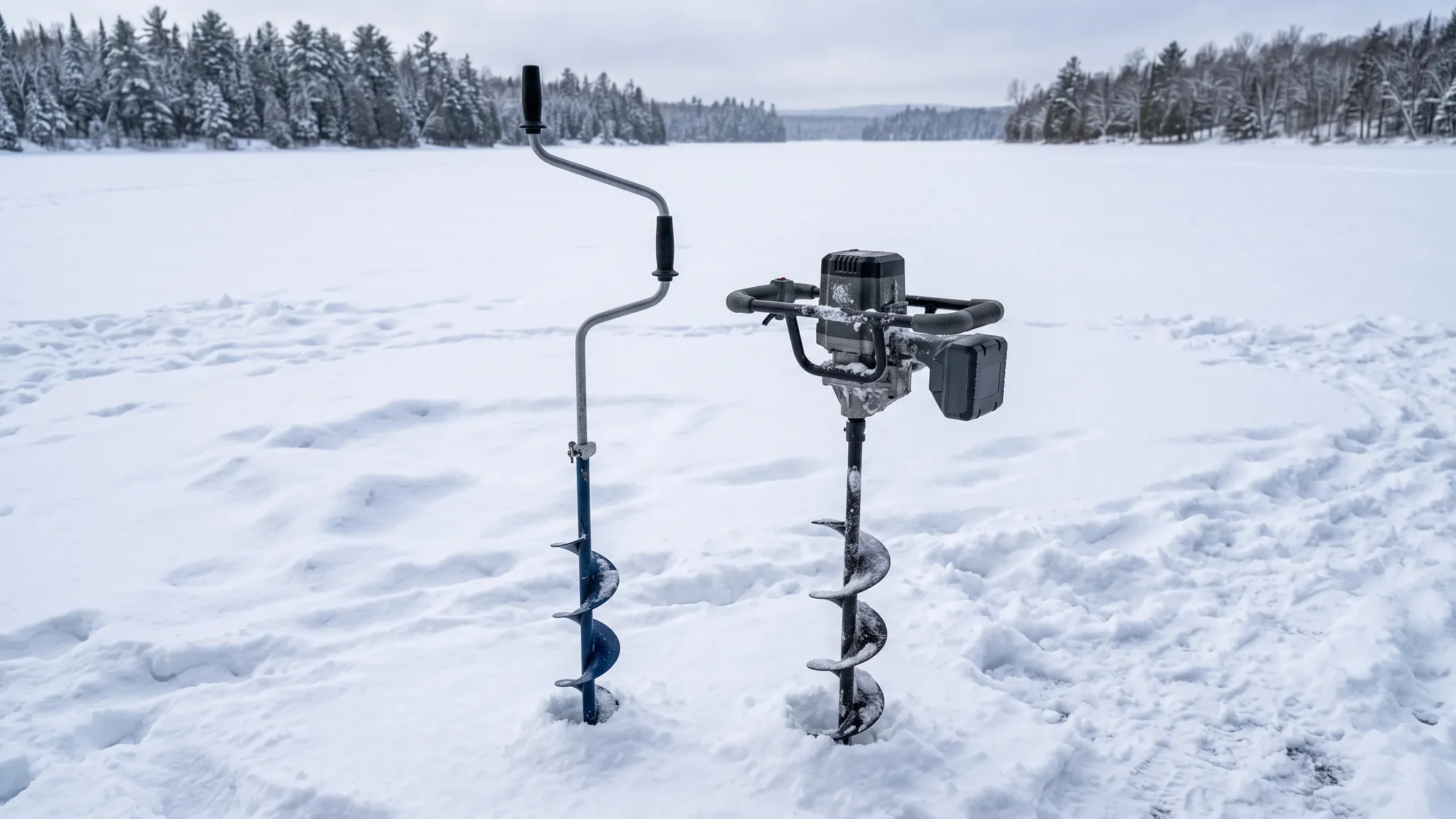
An ice auger cuts the hole, checks the thickness, and, with the right adapter, sets your shelter anchors, so it earns its place early on the list. We keep a full guide to the subject, How to choose an ice auger, and this section is the short version for readers building a whole kit.
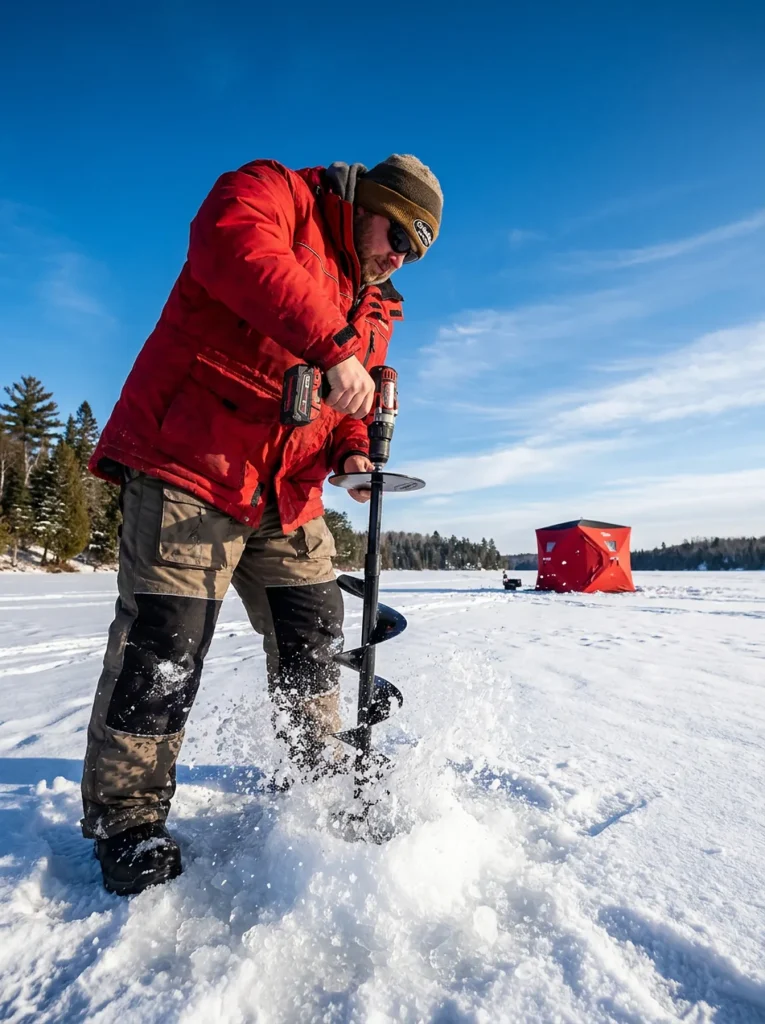
Augers sold for ice fishing fall into two designs. A drill-driven auger is the cutting unit alone: a shaft with spiral flighting and blades at the bottom, and an adapter that fits your cordless drill. A lithium power auger puts a similar cutting unit under a powerhead that has its own motor, battery, and handles. The first costs less because you supply the motor. The second is built for the job and tends to be more comfortable for a long line of holes.
If You Own a Strong Cordless Drill
The StrikeMaster Lite-Flite Lazer Drill Unit, 6-inch is $299.95. Its page says it works with a professional quality 18V (or higher) brushless hand-held cordless drill with a 1/2 inch chuck, or with a StrikeMaster ice auger power head. It weighs 4.4 lbs in the 6 inch size and comes with a blade guard, a two-stage drill adapter, and a protection flange. That last point matters if you ever move up to a powerhead: The same cutting unit goes under it.
The Eskimo Pistol Bit Auger starts at $289.95 for the 6-inch size and is a lightweight option at 3.9 lb. Eskimo says it was designed so you can carry it from hole to hole all day without much fatigue for you or your drill. Check the product page for the sizes in stock, since the 6-inch and 10-inch are the sizes it lists.
Either way, the drill matters as much as the auger. A light homeowner drill is not what these units are built for, so check the label on yours, and carry a second charged battery onto the ice because cold drains batteries faster than a warm garage does.
If You Drill Many Holes or Fish All Day
The StrikeMaster Lithium 24v Lite-Flite 6" Auger is $629.95. It has a brushless DC motor with a 50:1 planetary gear system, a deadman safety switch, forward and reverse, a 24 volt 4 amp hour lithium ion battery, and a charger that the page says recharges the battery in 2 hours. The battery and charger are included. The page also notes that this 24V powerhead can only be paired with Lite-Flite Lazer drills.
For the bigger hole, the StrikeMaster Maven Lithium 40V Lite Flite Auger is listed at $949.95 with two batteries, in 8-inch and 10-inch sizes (confirm the price for your size on the page). It is a brushless variable-speed power head with forward and reverse, a deadman safety switch, a built-in LED light and bubble level, and twin serrated stainless Maven blades. Its 40 volt 5 amp hour batteries come with a 2 amp rapid charging base.
Augers ship by quote, so call the store at (705) 253-2361 for a price to your door. Pickup at the store needs no quote.
The Small Auger Add-Ons That Save a Trip
- Eskimo One-Piece Ice Chisel ($94.95). Fully welded steel with a triple-action chipping head, a foam grip, and a wrist tether strap. It is the spud bar Ontario mentions for checking thickness as you walk.
- StrikeMaster Power 12" Auger Extension ($74.95). Bolts to the power head and adds 12 inches of boring depth for thick ice. Call us with your model first to confirm it fits.
- Rapala Swede-Bore 6" Auger Blade Cover ($15.95). A heavy-duty plastic guard with a holding strap. Blades do all the cutting, so a cover is a cheap way to protect the edge in a truck bed.
- Rapala Mega Scoop ($31.95) and Rapala Compact Mega Scoop ($16.95). Both clear slush from the hole. The full-size one has a 34 in handle, so you scoop standing up, plus a 30 in ruler that doubles as a fish and ice measure. The compact is 13.5 in and easier to keep on your person.
Ice Fishing Rods Are Short, Sensitive, and Built for a Hole Not a Cast
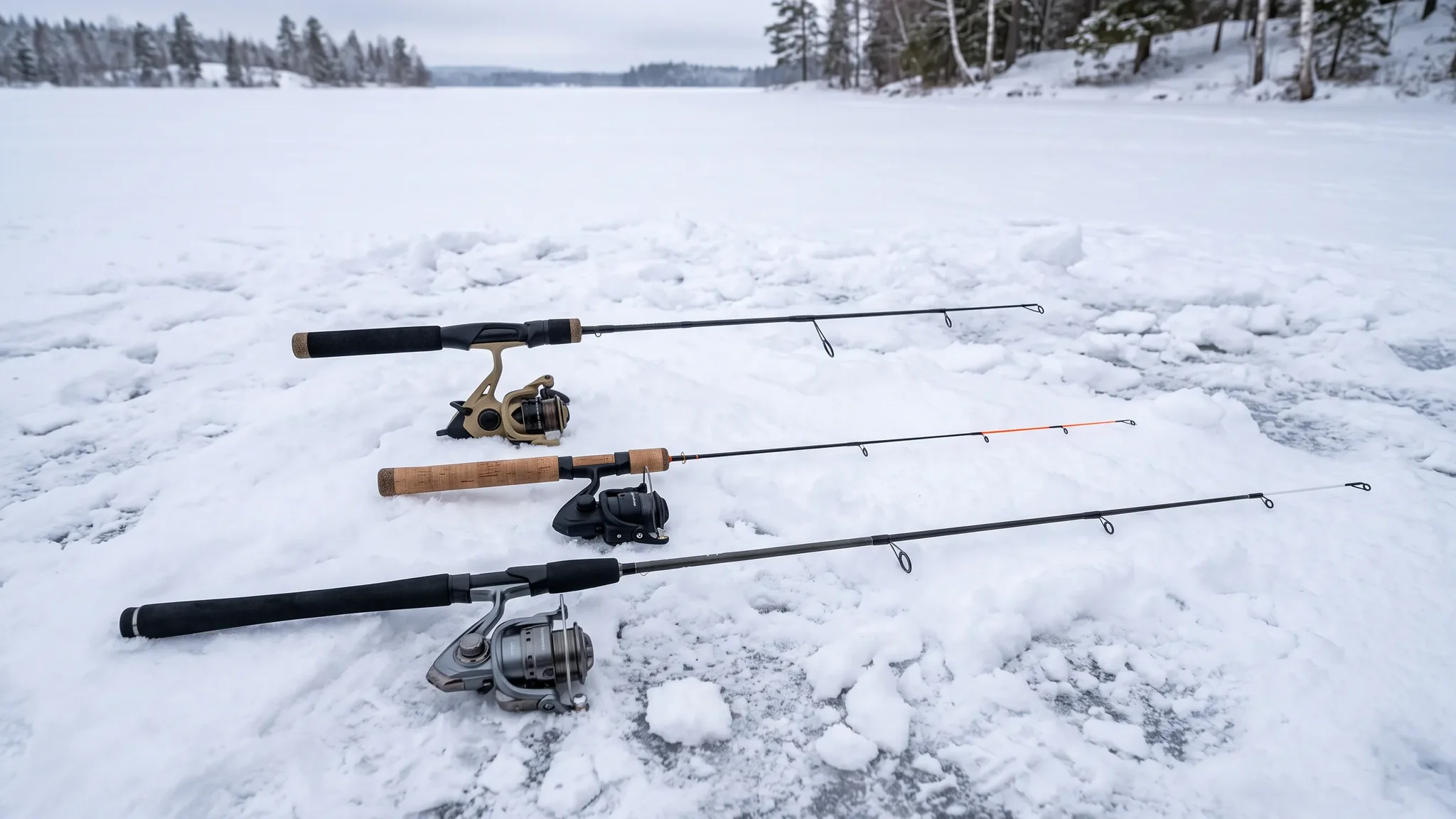
An ice rod looks like a toy next to an open-water rod, and that is the point. You fish straight down, often sitting or kneeling, and a short rod keeps the tip close to the hole and gives you a sharper read on a light bite. Rod makers describe them by length, power, and action: Length is how long the rod is, power is how much force it takes to bend it, and action is where along the blade it bends.
The ice rods on our shelves run from 24 inches to 42 inches. A shorter rod sits well in a small shelter and gives you control. A longer one lets you stand, work a bigger bait, or fish a deadstick off to the side. We cover the details in a separate rod guide, so what follows is the kit-building summary.
Match the Rod to the Fish You Want
Think of three bands. Light-power rods of around 24 to 28 inches suit small jigs and panfish, where the tip should show a bite that barely registers. Medium-power rods in the 28 to 32 inch range cover most perch and walleye jigging. Medium-heavy and longer rods of 32 inches and up handle bigger lures and bigger fish, such as lake trout or pike. These bands are a rule of thumb, not a standard, because makers label power and action differently.
| Rod or combo | Listed lengths and actions | Price |
|---|---|---|
| Shakespeare Ugly Stik GX2 Ice Fishing Rod | 26" L, 28" M, 30" MH | From $38.95 |
| 13 Fishing Force Ice Combo | 24" L, 26" ML, 28" M | From $49.95 |
| Fenwick Eagle Ice Rod | 28" M, 28" ML, 30" L, 32" MH | From $54.95 |
| Shimano Convergence Ice Rod, Spinning | 28" M | From $59.95 |
| 13 Fishing Capture Walleye Ice Combo | 26" ML, 28" M, 36" M, 36" MH | From $79.95 |
| Fenwick Elite Tech Ice Rod | 28" M, 32" M, 42" M | From $79.95 |
| 13 Fishing Baitstriker Ice Combo | 36" Med Light Dead Stick, 36" Med Mod Dead Stick | From $169.95 |
The prices above are the listed prices at the time of writing. The lengths are the options on each product page, and the page lets you choose one.
Starter Rods and Combos
If you want one purchase that works the same day, a combo is the simple route. The 13 Fishing Force Ice Combo ($49.95) pairs a solid fiberglass rod with a Hi-Vis tip and a ported-spool reel with a slide drag, in 24, 26, and 28 inch lengths. A high-visibility tip is a plain way to see a bite when you are watching the rod instead of feeling for it.
The Ugly Stik GX2 ($38.95) is the lowest-priced rod on the list. Its page describes a genuine Ugly Stik blank with a Clear Tip design, a twist-lock reel seat with EVA handles, and one-piece stainless steel guides. It is a rod only, so budget for a reel and line.
Step-Up Rods for Sensitivity
The Fenwick Eagle ($54.95) has a solid carbon blank for sensitivity and durability, stainless steel guides with aluminum oxide inserts, and a burled cork handle. The Fenwick Elite Tech ($79.95) keeps the solid carbon blank and adds a Fuji reel seat with an exposed blank design. Its page says the series is designed for techniques ranging from ultra lightweight finesse fishing for bluegill to heavy jigging for lake trout, which is why it comes in 28, 32, and 42 inch lengths.
The Shimano Convergence ($59.95) is offered in a 28 inch medium spinning model. Its Zirconia guides and a hook keeper set further from the reel seat are designed to leave room for your finger on the blank, which improves sensitivity.
The 13 Fishing Capture Walleye Ice Combo ($79.95) has a solid fiberglass rod with an Evolve titanium spring bobber built in, a 2 ball bearing reel, and options in 26, 28, and 36 inch lengths. A spring bobber is a thin flexible tip that shows a bite by moving, which is useful when you are fishing a slow bait such as a minnow.
Reels, and the One That Changes How You Fish
Most ice reels are small spinning reels, in a 1000 or 2000 size, with a light drag. The reel listed on its own in our ice fishing reels category is the 13 Fishing Baitstriker Reel ($119.95) in sizes 1000 and 2000. It has a BaitStriker switch for hands-free deadstick fishing, 7 stainless steel ball bearings plus instant anti-reverse, a carbon body and rotor, an aluminum spool, and a competition-grade slide drag.
The 13 Fishing Baitstriker Ice Combo ($169.95) pairs that reel with a solid fiberglass dead stick rod with a Hi-Vis quick tip, in 36 inch Medium Light and Medium Moderate versions. A dead stick is a rod that sits in a holder with a live bait or a lure, and you watch it for a bite instead of working it by hand.
Protect the Rods You Buy
Ice rods are short but fragile. The Rapala Ice Combo Locker in the large size ($54.95) is a soft-sided, padded rod bag in Digi-Camo for 36 to 42 inch rods, with a water-resistant shell and an inside pocket for spools of line and terminal tackle. For shorter rods, the Rod Glove for 23 inch rods ($6.95) and the 30 inch version ($7.95) keep the tip from catching on everything in the truck.
Ice Line Should Resist Freezing Before It Does Anything Else
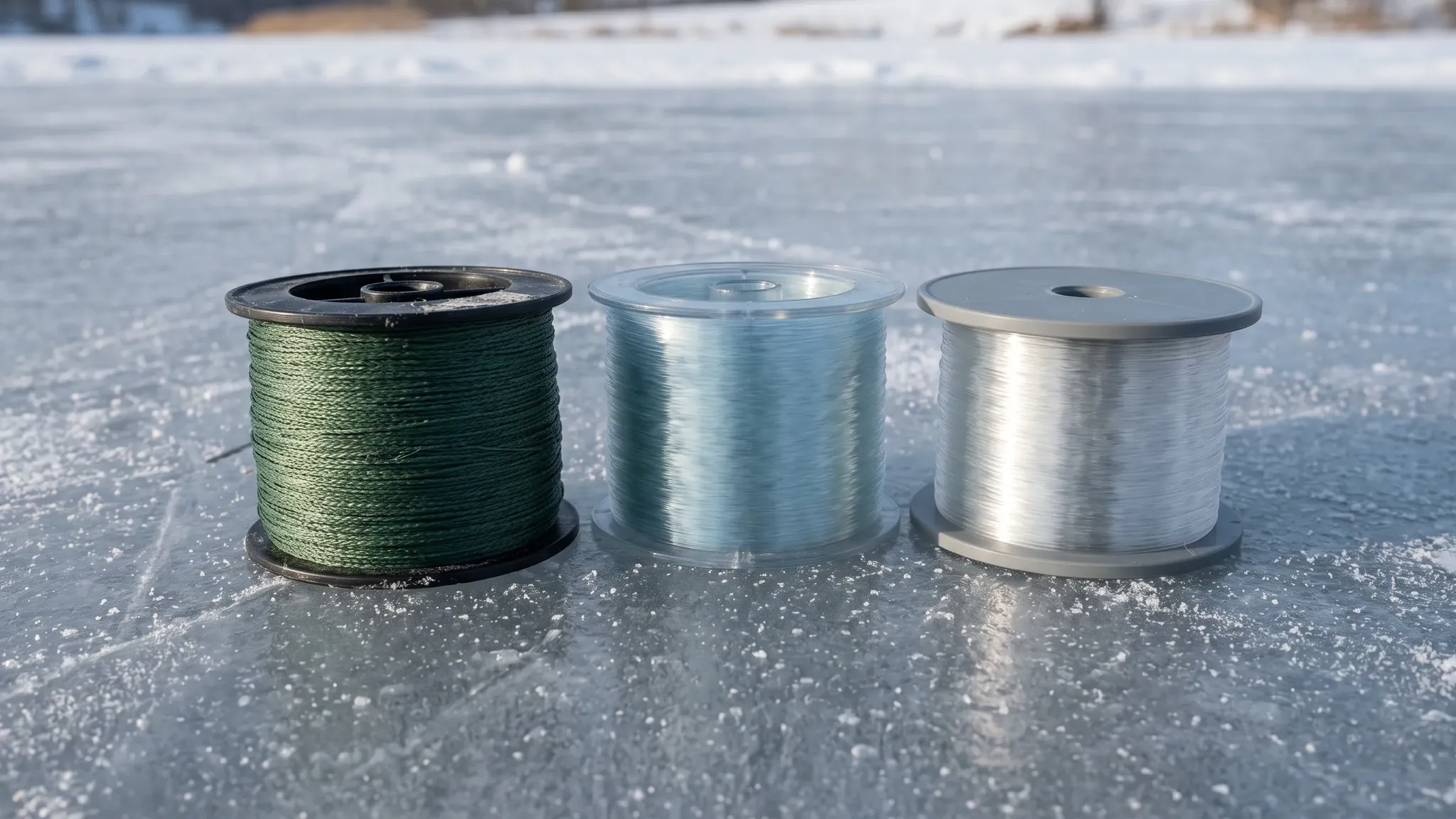
Line is the cheapest part of an ice fishing kit and the part that fails first when it is the wrong kind. Water on a spool freezes. Line that holds water turns stiff, coils off the reel, and tangles in the guides, so most ice lines are sold with a coating that sheds water. That feature appears in the descriptions of every ice line we carry, and it is the first thing to look for on a package.
After that, the choice is between three materials: braid, monofilament, and fluorocarbon. Each has a place, and many anglers carry more than one spool.
| Line | What the product page says | From |
|---|---|---|
| Sufix Advance Ice Monofilament | Supple, sensitive, 50% lower stretch than standard monofilament, hydrophobic protection that resists freezing; 2 to 12 lb test | From $9.49 |
| Sufix Advance Ice Fluorocarbon | 100% fluorocarbon, water-repellent coating that reduces line freeze, low memory, nearly invisible when submerged; 4, 6, and 8 lb | From $13.95 |
| Sufix 832 Ice Braid | 7 HMPE fibers plus 1 GORE Performance Fiber, 32 weaves per inch, hydrophobic finish that resists freezing; 4 to 30 lb | From $14.49 |
| PowerPro Ice-Tec Ice Fishing Line | 50 yard spools in Ice Blue; 5, 8, 10, and 15 lb test | From $14.95 |
Prices shown are the lowest listed price for each line, and the cost rises with the test strength and size you choose on the product page.
Monofilament: The Forgiving Place to Start
Monofilament stretches a little, which forgives sudden runs, hook sets, and rough knots. The Sufix Advance Ice Monofilament (from $9.49) blends HMPE and a Hyper CoPolymer for a supple, abrasion-resistant mono. Its page lists 50% lower stretch than standard monofilament, plus low memory from G2 Precision Winding. It comes in Clear and Neon Lime in 2, 3, 4, 6, 8, 10, and 12 lb test. Neon Lime is easier to see against the snow at the top of the hole, and clear is harder for fish to see below it.
Fluorocarbon: A Near-Invisible Leader or Main Line
Fluorocarbon is chosen for how little it shows in the water. The Sufix Advance Ice Fluorocarbon (from $13.95) is a 100% fluorocarbon line with a water-repellent coating that reduces line freeze, low memory, and strong shock absorption and knot strength. The page lists 4, 6, and 8 lb sizes in 50-yard spools. Many ice anglers use fluorocarbon as a leader below braid or monofilament, and we would suggest asking us which test fits the lures you plan to fish.
Braid: Small Diameter for Light Lures
Braid has almost no stretch and a very small diameter for its strength, which shows a light bite more clearly and lets small lures sink straight. The Sufix 832 Ice Braid (from $14.49) is listed with a 4 lb test of 0.004 in diameter (0.10 mm) and a 10 lb test of 0.008 in (0.20 mm), on 50 yard spools, in Camo, Fire Camo, Ghost, and Neon Lime. The PowerPro Ice-Tec ($14.95) is another 50 yard ice braid, in Ice Blue and four tests.
Braid has no stretch to absorb a hard hook set, so pair it with a rod that has some give, and tie a fluorocarbon leader if you want the invisibility.
Which Test Strength? Match It to the Fish and the Rod
Lighter line suits small fish, small lures, and light rods. Heavier line suits walleye, pike, and lake trout, and tip-ups. The ice lines we list begin at 2 lb monofilament and reach 30 lb braid for rods, and 15 to 50 lb for tip-up line. As a general rule, match the line to the rod's rating, since a rod and line that disagree make a poor team, and ask us to confirm if you are unsure.
Tip-Ups Let You Watch More Than One Hole Without Holding a Rod
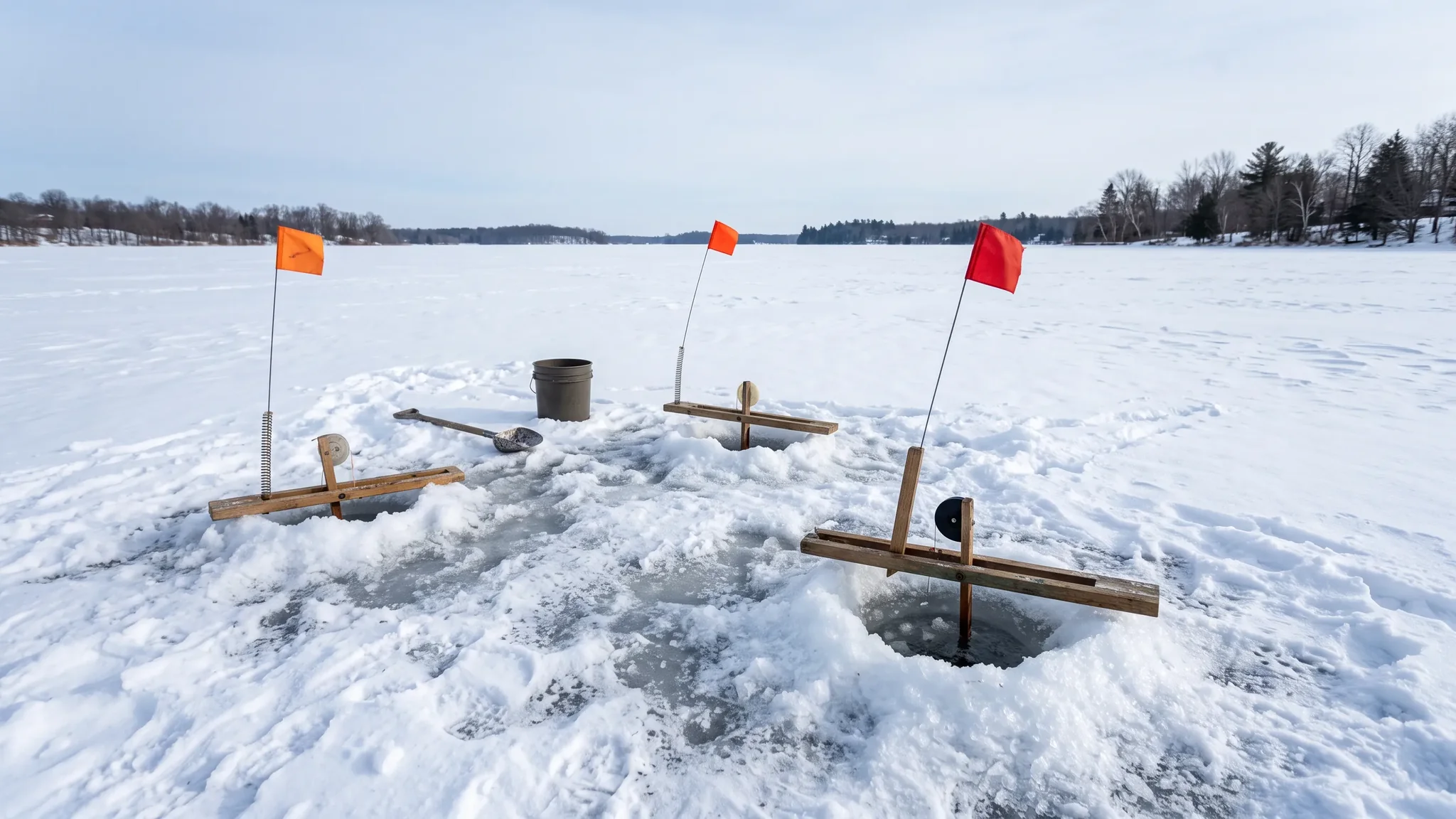
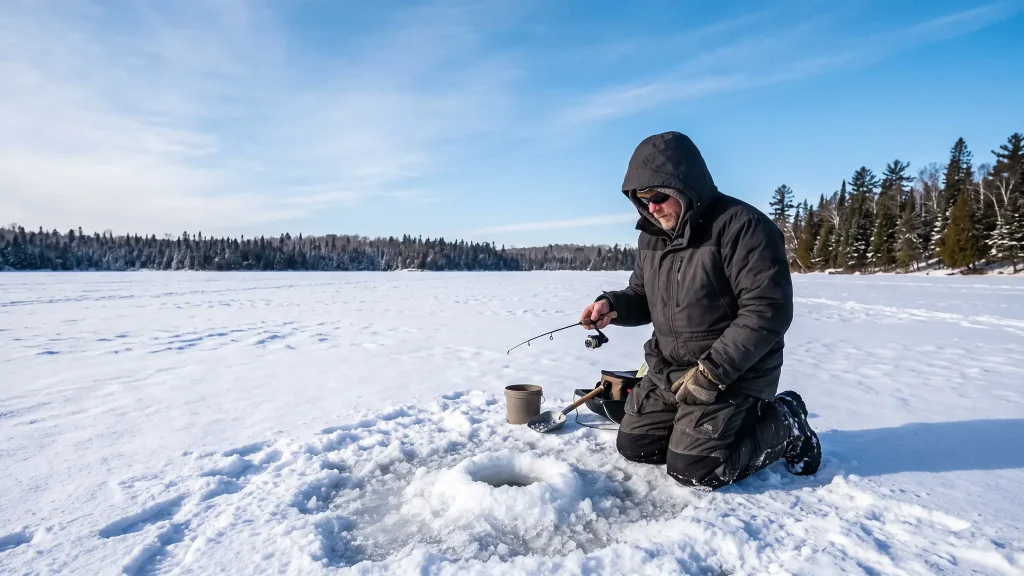
A tip-up sits over a hole with line on a spool and a flag. When a fish takes the bait, the mechanism releases and the flag goes up, and you walk over to land the fish. It is the oldest way to cover extra holes, and it works especially well for bigger fish such as pike, walleye, and lake trout, because the bait can stay put while you work a jig on a nearby hole.
Ontario's rule on lines is the thing to remember: In most waters you may ice fish with two lines, as long as you stay within 60 metres (197 ft) of any line or tip-up and have a clear and unobstructed view of your lines at all times. The page also says you may not bring a device that uses a mechanical spring to set the fishing hook (other than a fishing rod under tension) within 30 metres (98 ft) of any waters. Read the full page and the Recreational Fishing Regulations Summary before you set a tip-up, since it is your responsibility to stay inside the rule.
Two Tip-Ups We Carry
- Rapala Thermal Tip-Up ($30.95). The insulated body covers the hole and helps prevent freeze-up on holes up to 10 inches. It has two bite settings from light to heavy, a flag indicator, and on-board storage for hooks, weights, and leader (not included). It folds for travel and fits and stacks in most 5 gallon or larger buckets.
- Clam Arctic Warrior Deadstick Tip-Up System ($59.95). When a fish bites, the unit tips down and the flag goes up. You grab the rod and reel, set the hook, and fight the fish with no hand-over-hand retrieval. Clam says it works well as a secondary line for walleye, northern pike, lake trout, and jumbo perch.
Tip-Up Line and the Reels That Hold It
Tip-up line is heavier than jigging line because it has to handle bigger fish and a longer fight. The Sufix Performance Tip Up Ice Braid (from $8.95) is a 50 yard high tenacity polyester braid with abrasion resistance, low stretch, and good cold-weather handling, in 15, 20, 30, and 50 lb test.
For a ready-to-fish setup, the Rapala Rattle Reel with SmartHub ($44.95) comes pre-loaded with 25 yd of Sufix 30 lb Rattle Reel Line, with a variable spool tension knob and a built-in hook keeper. Its page says it mounts on flat surfaces or on a Track System 16.
The Eskimo Universal Ice Anchor Drill Adapter ($29.95), which we mentioned for anchors, also reels up tip-ups when attached to a cordless drill. That is a real help with cold, wet hands.
Small Items Make a Shelter Comfortable and Keep Your Tackle Where You Can Find It
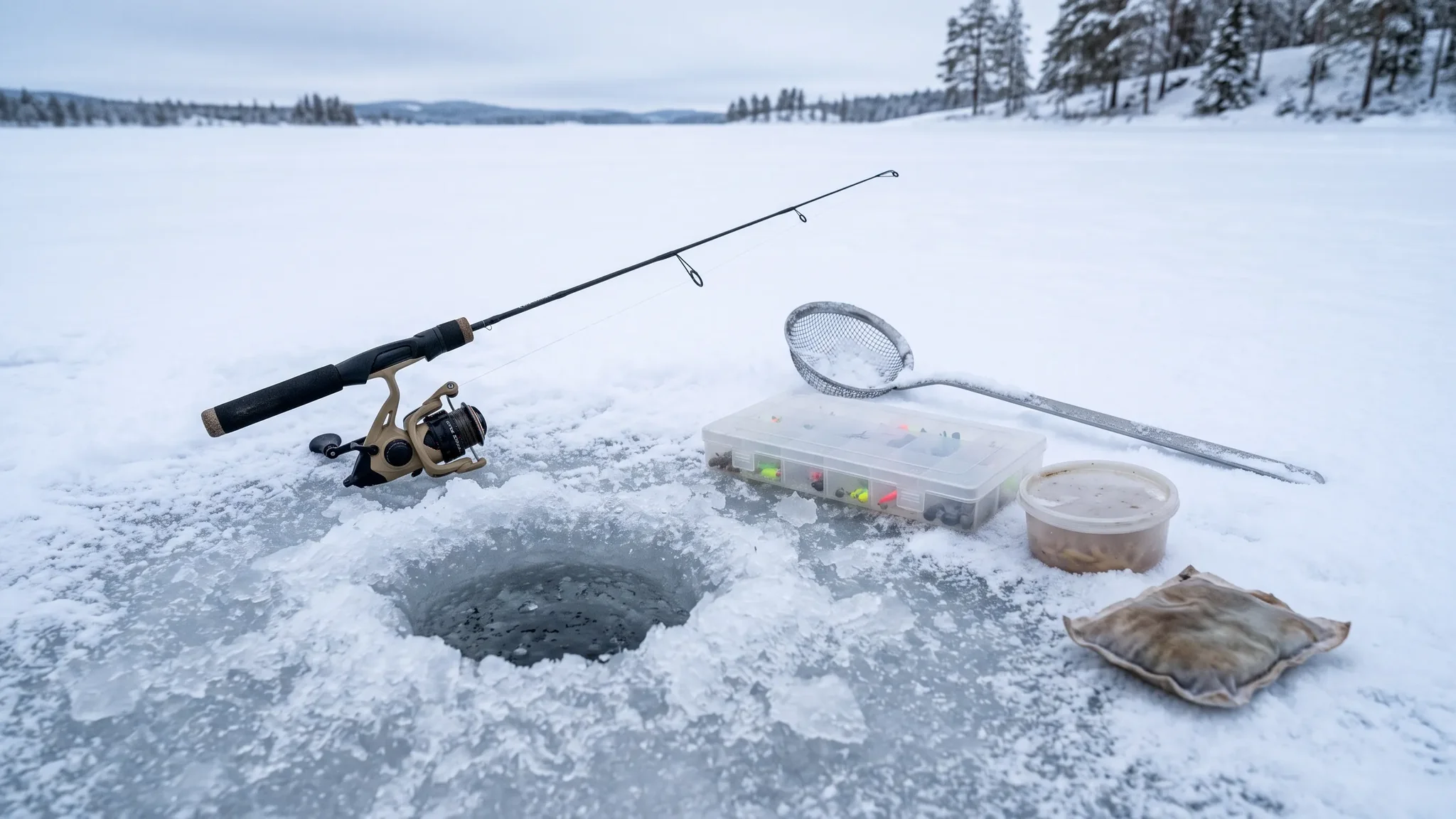
Once you have a shelter, you need a way to keep gear from ending up in a pile. The Rapala Track System 16 with SmartHub ($29.95) is one answer. Rapala SmartHub accessories slide over the connector and click into place, and the hub can be positioned anywhere along the track and locked with a set screw. You can swap and reposition accessories as your setup changes.
Other items we would add, in the order most people feel the need for them:
- A scoop. Slush forms on the hole all day, and a scoop clears it (see the Rapala Mega Scoop above).
- A bucket or seat. A five gallon bucket doubles as a seat, a tackle bin, and a carrier for tip-ups. The Rapala Thermal Tip-Up page notes it stacks in a 5 gallon bucket.
- Rod protection. A rod locker or rod gloves, as covered earlier.
- A foam mat. Insulation underfoot keeps the cold out of your boots.
- A light. Winter days are short, and a headlamp lets you land the last fish safely. The Rapala Thermal Tip-Up page mentions a small hole in the base that holds a light stick for night use (not included).
Lures and Terminal Tackle
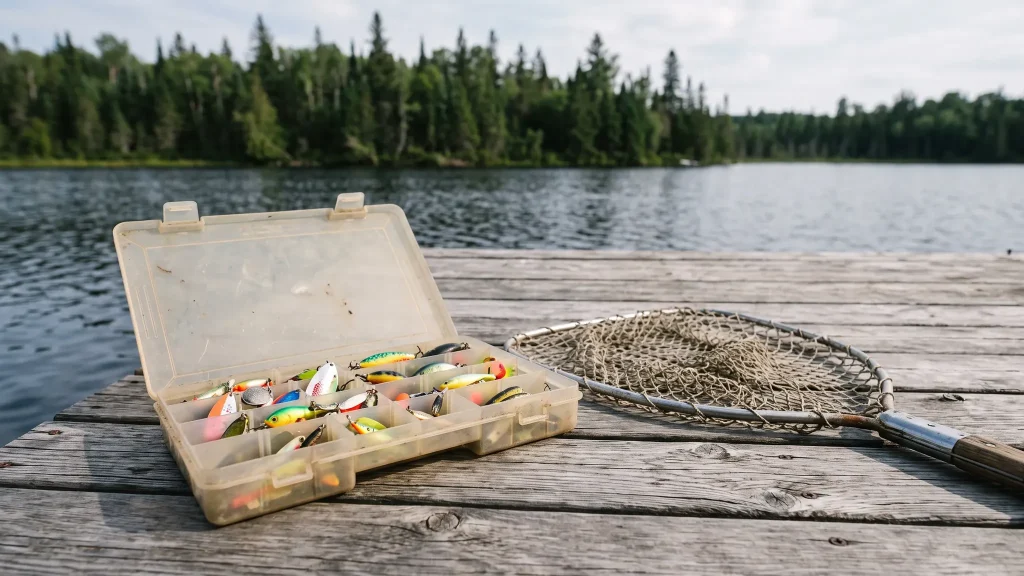
We have not built this guide around specific lures, because what works depends on the lake, the species, and the week. The Ice Fishing category and the rest of our fishing department show what is on the shelves now. Ask at the store which jigs, spoons, and baits are catching around the Sault, since the best local information is what other anglers have been using this month.

Dress for the Hours You Plan to Sit Still
Ice fishing is slow. You move to the hole, drill, and then you sit, so the clothing that works for a hike makes you cold within an hour on the ice. The Ontario page lists wearing "appropriate clothing and equipment for safety and comfort" among the things to do before you venture out, and the Lifesaving Society adds that a brightly coloured lifejacket or PFD over layered winter clothing is a fallback if you do not have a thermal protection buoyant suit.
The clothing we carry that suits long, still days includes:
- Outdoor Research Deming Fleece Beanie ($49.95). A breathable, quick-drying fleece beanie in a polyester and wool blend, with a tall folded cuff that covers the ears when the temperature drops.
- Outdoor Research Team Gore-Tex Mitt ($199.95). A waterproof Gore-Tex mitt with a goat leather palm, VerticalX Eco insulation, and a merino wool fleece palm lining. The page notes that mitts keep fingers together for more warmth.
- Outdoor Research Women's Transcendent Down Parka ($379.95). A lightweight, water-resistant, wind-resistant parka with 800+ fill power down and an insulated hood.
- Outdoor Research Women's Rialto Fleece Lined Pants ($174.95). Water-resistant, wind-resistant, with a soft fleece lining and a DWR-treated shell.
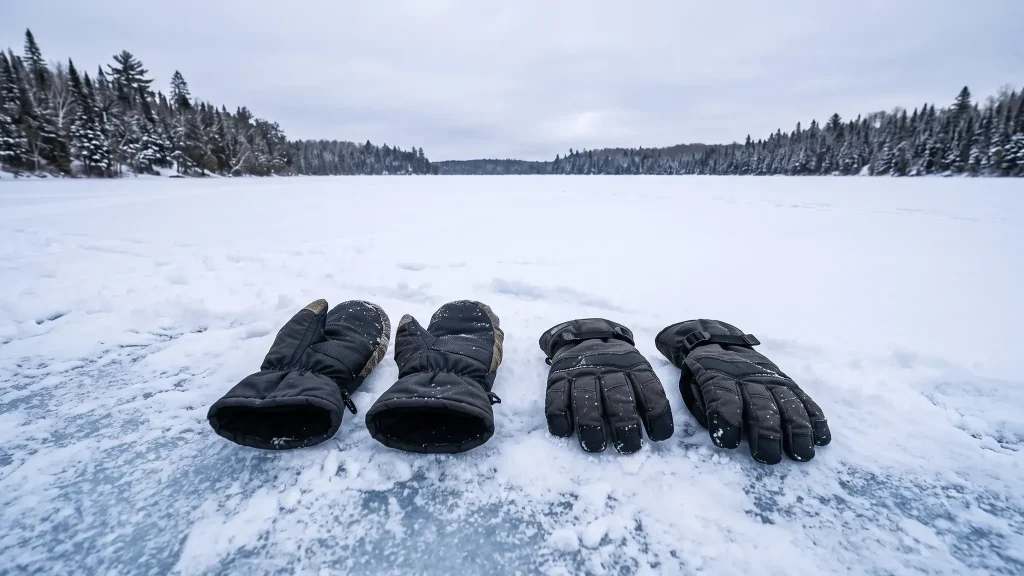
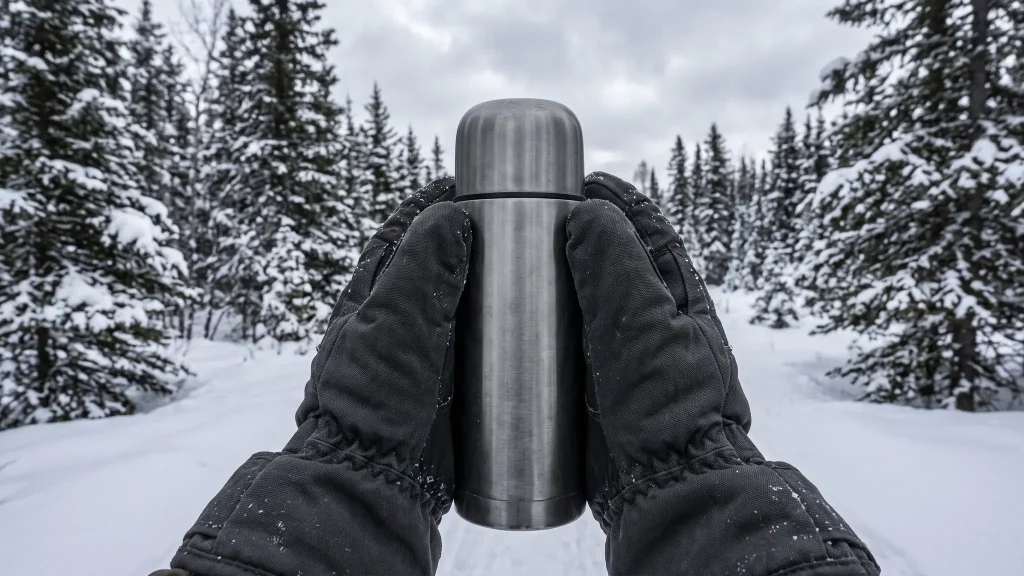
Our winter gear section has more, and the staff can help you fit a layering system. Three habits matter more than any single item. Keep a dry spare pair of gloves or mitts in a pocket, because wet hands in cold air lose heat fast. Layer so that you can open a zip in the shelter and avoid sweating. And bring a hot drink, since warm fluid does as much for patience as any jacket.
Three Ice Fishing Kits at Three Budgets, With the Arithmetic Shown
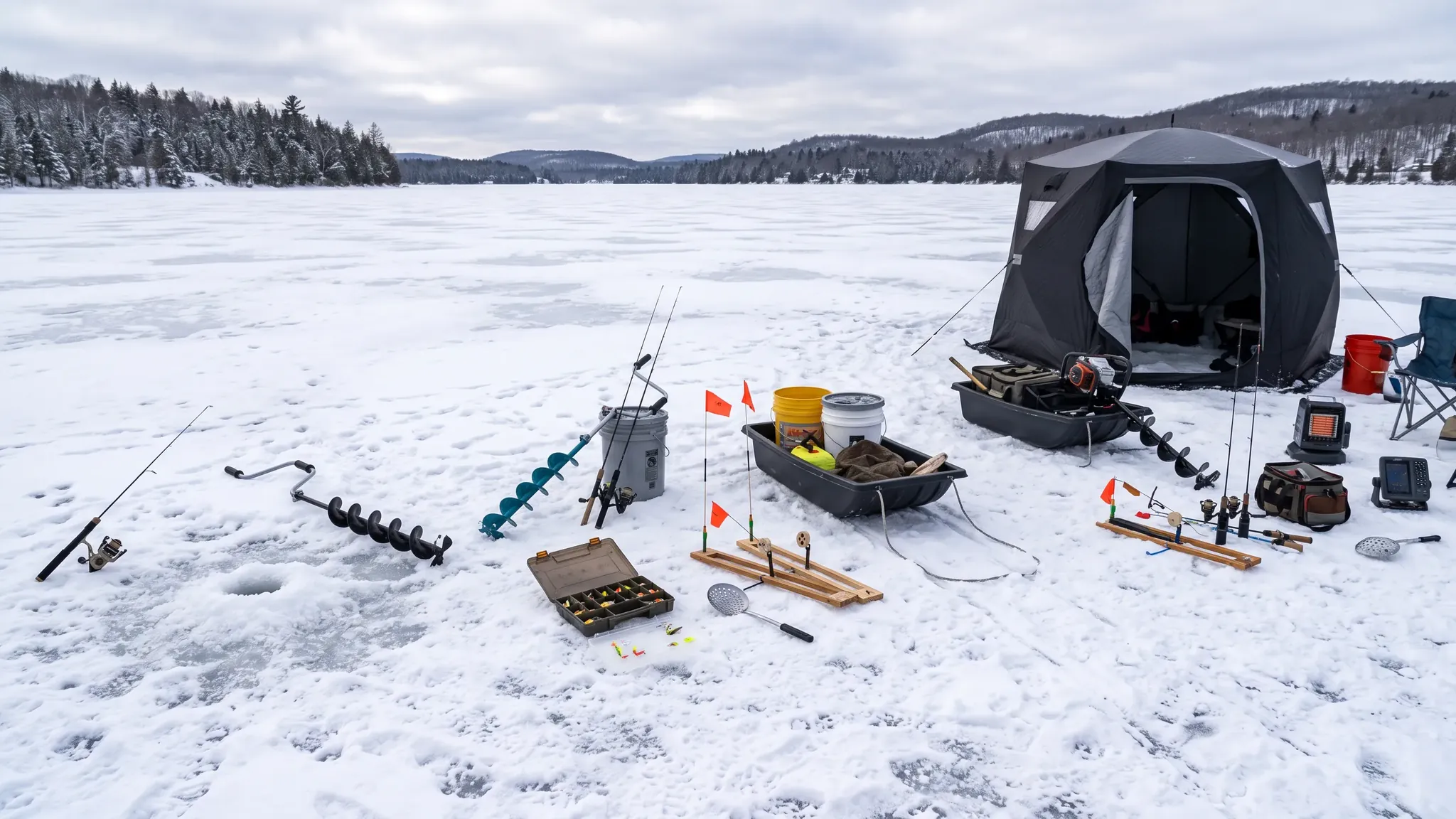
A list of products does not tell you what to buy first, so here are three sample kits built only from items on our shelves, with the prices added up from the listed prices at the time of writing. Treat them as starting points. Line costs rise with the test and size you pick, so each kit uses the lowest listed price for line, and the totals exclude tax and shipping.
Kit One: A Walk-In Starter for One Angler Who Fishes Beside Friends
This kit assumes someone else in your group brings the shelter and drills the holes, and you want to be a useful part of the day without a big spend. It is rod, line, safety, and tidiness.
| Item | Price |
|---|---|
| 13 Fishing Force Ice Combo | From $49.95 |
| Sufix Advance Ice Monofilament (from) | From $9.49 |
| Rapala Steel Spike Ice Claws | From $17.49 |
| Rapala Compact Mega Scoop | From $16.95 |
| Rod Glove, 23 inch | From $6.95 |
| Total | From $100.83 |
The point of this kit is to put you on the ice with a working rod and the safety item that matters most. If the season goes well, the next purchases are an auger and a second rod.
Kit Two: Two Anglers Who Own a Good Drill but Not a Shelter
This is for two friends who drive to the lake, drill their own holes, and fish in the open or from a shelter they borrow or buy later.
| Item | Price |
|---|---|
| StrikeMaster Lite-Flite Lazer Drill Unit, 6-inch | From $299.95 |
| Two 13 Fishing Force Ice Combos at $49.95 | From $99.90 |
| Sufix Advance Ice Monofilament (from) | From $9.49 |
| Two Rapala Steel Spike Ice Claws at $17.49 | From $34.98 |
| Rapala Mega Scoop | From $31.95 |
| Total | From $476.27 |
The auger is about 63 percent of the cost, and it is the item that lets you pick your own spot and check the ice yourself. It assumes the drill your auger will run on is already in your shop and meets the 18V brushless, 1/2 inch chuck description on the product page.
Kit Three: A Hub Shelter, an Auger, and a Pair of Better Rods
This kit is for two or three anglers who plan to fish most weekends and want to stay out of the wind. It assumes you already own a suitable cordless drill.
| Item | Price |
|---|---|
| Clam X-400 Thermal Ice Shelter Hub (8 anchors included) | From $899.95 |
| StrikeMaster Lite-Flite Lazer Drill Unit, 6-inch | From $299.95 |
| Two 13 Fishing Capture Walleye Ice Combos at $79.95 | From $159.90 |
| Two Sufix 832 Ice Braid spools (from) at $14.49 | From $28.98 |
| Rapala Thermal Tip-Up | From $30.95 |
| Rapala Mega Scoop | From $31.95 |
| Two Rapala Steel Spike Ice Claws at $17.49 | From $34.98 |
| Total | From $1,486.66 |
The shelter is about 60 percent of the total, which is typical for a first full setup. If the budget is tight, buy the shelter last. A season of fishing in the open teaches you what you actually need from one.

Buy in This Order If You Are Building Your Ice Fishing Gear Over a Season
Most people do not buy everything at once, so the order matters more than the shopping list. This is the sequence we would suggest, and the reason for each step.
- Safety first. Ice claws, a way to check thickness (a chisel or an auger), and a flotation layer or PFD, as the Lifesaving Society describes. Nothing else on the list matters without these.
- One good rod and line. A combo covers both in one purchase. Fish with it a few times to learn what you want next.
- A scoop and a rod protector. They are cheap and fix the two most irritating problems on the ice, which are slush in the hole and a snapped tip in the truck.
- An auger. It gives you independence. Start with a drill-driven unit if you own a strong drill.
- A shelter and anchors. It is the largest purchase and the one where knowing your group size and your access to the lake pays off.
- Tip-ups and extras. These add coverage and comfort once the basics work.
Common Mistakes With Ice Fishing Gear
- Buying a shelter for the wrong group. A tent sized for four that you use alone wastes weight, and one sized for two that you share with three makes for a tense day.
- Using a light drill on a big auger. Check the drill requirement on the auger page before you buy.
- Leaving anchors to chance. A shelter that moves in the wind is a hazard and a nuisance. Set every anchor.
- Skipping the registration check. It is free, and Ontario requires it for some huts in our zone.
- Treating heat as a given. A fuel-burning heater in an enclosed tent is a carbon monoxide risk. Warm clothing comes first.
- Trusting yesterday's ice. Both Ontario and the Lifesaving Society say ice conditions can change quickly. Measure again.
When to Shop for Ice Fishing Gear
Ice fishing starts when the ice is safe, not on a fixed date, so we would not tell you to buy by a certain day. Gear is easier to choose before the first cold snap than in the rush after it, and augers ship by quote, so allow time if you need one sent to you. Call the store at (705) 253-2361 and we can tell you what is on the shelf before you drive over.

Getting Your Gear to the Hole Is a Safety Decision Too
A shelter, an auger, and a bucket of tackle weigh more than people expect, and many anglers get them to the water by snowmobile or truck. Ontario's ice fishing page gives thickness numbers for travel on the ice: Snowmobiles need at least 20 centimetres (8 inches) of clear blue ice, and light vehicles need 30 centimetres (12 inches) or more. It says to double the thickness if the ice is white or opaque, and it notes that heavy snow on a frozen lake or river slows down the freezing process.
The Lifesaving Society's numbers are lower: 5 inches (12 cm) for a snowmobile or ATV, and 8 to 12 inches (20 to 30 cm) for a single car. The two sources do not agree, and the difference is a good reason to read each page yourself and plan around the stricter figure. Neither source is a guarantee, because both say conditions change. The Society also reports that approximately half of ice-related fatalities happen during recreational activity, and that of those, nearly 2 in 5 involved travelling by snowmobile.
What this means for the gear you carry:
- Know the weight of what you tow. The Clam X-400 lists a 50 lb pack weight, and an auger, a power battery, a bucket, and a seat add to it. Spread the load across a sled and keep it low.
- Drill as you go. A drill-driven or powered auger is the thickness gauge Ontario recommends using as you move farther out.
- Keep the claws and the rope outside the load. If you need them, you will not have time to unpack a sled.
- Do not travel at night or in poor visibility. The Lifesaving Society advises avoiding ice at night or when visibility is reduced.
- Ask locals. The Society suggests talking to locals or people such as a bait shop operator or resort owner for known ice conditions and thin ice areas. Ontario suggests checking with local ice hut operators or other anglers. We are happy to share what we hear at the store, with the caveat that conditions change by the day.
What to Do If You Break Through
The Lifesaving Society's advice is worth reading before you need it. Do not panic, because the clothes you are wearing will trap air and keep you buoyant for a short time. Turn toward the direction you came from, place your hands and arms on the unbroken ice, kick your feet, and push yourself forward onto the ice on your stomach. Spread your weight out as much as possible. Once you are lying on the ice, do not stand up: Roll, crawl, or shimmy away from the break until you are on solid ice or land. The Society also calls out two myths worth knowing. Snow on a frozen lake does not make the ice stronger, because snow acts as an insulating blanket that hinders ice growth. And thick ice is not always strong, because "rotten" ice that has frozen and thawed repeatedly can be fragile even when it looks solid.
Practise reaching for your ice claws with gloves on, at home, before the season. It costs you nothing, and it is the kind of habit that is hard to build in cold water.
Questions
How big a shelter do I need for two or three anglers?
Plan on the fishable floor area, not the sleeping count. The Clam X-400 we carry offers 64 square feet and is listed for 3 to 4 anglers comfortably, so it suits two or three people with chairs, buckets, and a couple of holes. Fishing alone or walking in, a smaller, lighter shelter makes more sense. Call us with your group size and we will help you match one.
Flip-over or pop-up: which suits Northern Ontario lakes?
It depends on how you reach the water. Flip-overs tow as a single unit on a sled, pop-ups set up fastest for anglers who move holes often, and hub shelters give the most room for the weight. Wind is the common thread on big water, so strong anchors matter for all three. We currently list one hub shelter, so call us about other styles.
How do I anchor a shelter in wind?
Set an ice anchor at every strap point on the shelter before you start fishing. Self-tapping anchors with large handles, such as the Eskimo Ice Anchors, twist in with gloves on, and a cordless drill with an anchor adapter does the work faster. The Clam X-400 includes eight anchors. Check the weather, and move or take the shelter down if gusts grow beyond what it can handle.

Come See the Ice Fishing Gear at Our Store in Sault Ste. Marie
The easiest way to pick a shelter is to see it, and the easiest way to match an auger is to bring your drill. Visit Great Lakes Outfitters at 162 Old Garden River Rd, Sault Ste. Marie, ON P6B 5A6, or call us at (705) 253-2361. Tell us how many of you fish, how you reach the water, and what you already own, and we will build the kit from there.
Talk to us about it
- 162 Old Garden River Rd, Sault Ste. Marie, ON P6B 5A6
- (705) 253-2361
- Open today 10 a.m. to 6 p.m.
- Send us a message
References
- Government of Ontario: Ice fishing (licence, lines, hut registration and removal dates, ice safety tips, driving on ice).
- Government of Ontario: Fisheries management zones (FMZ 10 covers Sault Ste. Marie and Sudbury).
- Lifesaving Society: Cold water and ice (minimum ice thickness, safety kit, what to do if you break through, ice myths).
- Health Canada: Carbon monoxide, preventing exposure (fuel-burning equipment and heaters in enclosed spaces).
- Health Canada: Carbon monoxide overview (properties of the gas, tents as higher-risk spaces).
About the author
Steve Meating
Owner
I take care of the entire fishing category and some of our other categories. I also look after our online store.
More from Steve Meating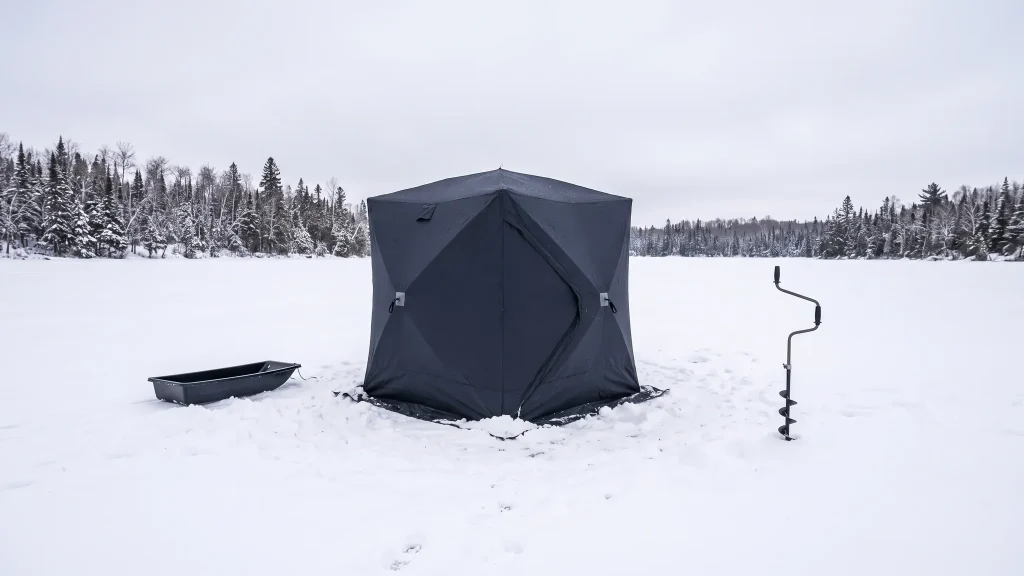

 English (Canada)
 Français du Canada