

Fishing Kayaks: Stability, Storage, and Rod Holders
Choosing a fishing kayak starts with one question: Will it stay steady under you while your hands are busy casting, netting a fish, or reaching for gear? We'll walk you through hull stability first, then storage, rod holders, and the pedal-or-paddle decision, using the kayaks we carry at our store in Sault Ste. Marie.
TL;DR
- Why stability comes first, and which hulls give it
- Standing to cast in shallow water
- A lifejacket you can fish in
- Storage that suits your gear
- Rod holders: flush-mount, troughs, and add-ons
- Pedal or paddle
- Where to see them in Sault Ste. Marie
Who this article is for
- First-time anglers buying their first fishing kayak
- Paddlers moving from a recreational kayak to a fishing setup
- Anglers who want to stand and cast from the kayak
- Buyers deciding between a pedal drive and a paddle
Kevin Coombs
Sales Representative
A note from the author
We wrote this guide around the fishing kayaks and gear we sell at 162 Old Garden River Road. Every product named in it is one you can buy from us, priced as it was on our store the day this went up. If you have questions about a hull, a rod holder, or which setup suits your water, call us or come in and we'll talk it through.
Stability Decides Whether a Fishing Kayak Is Any Good to You
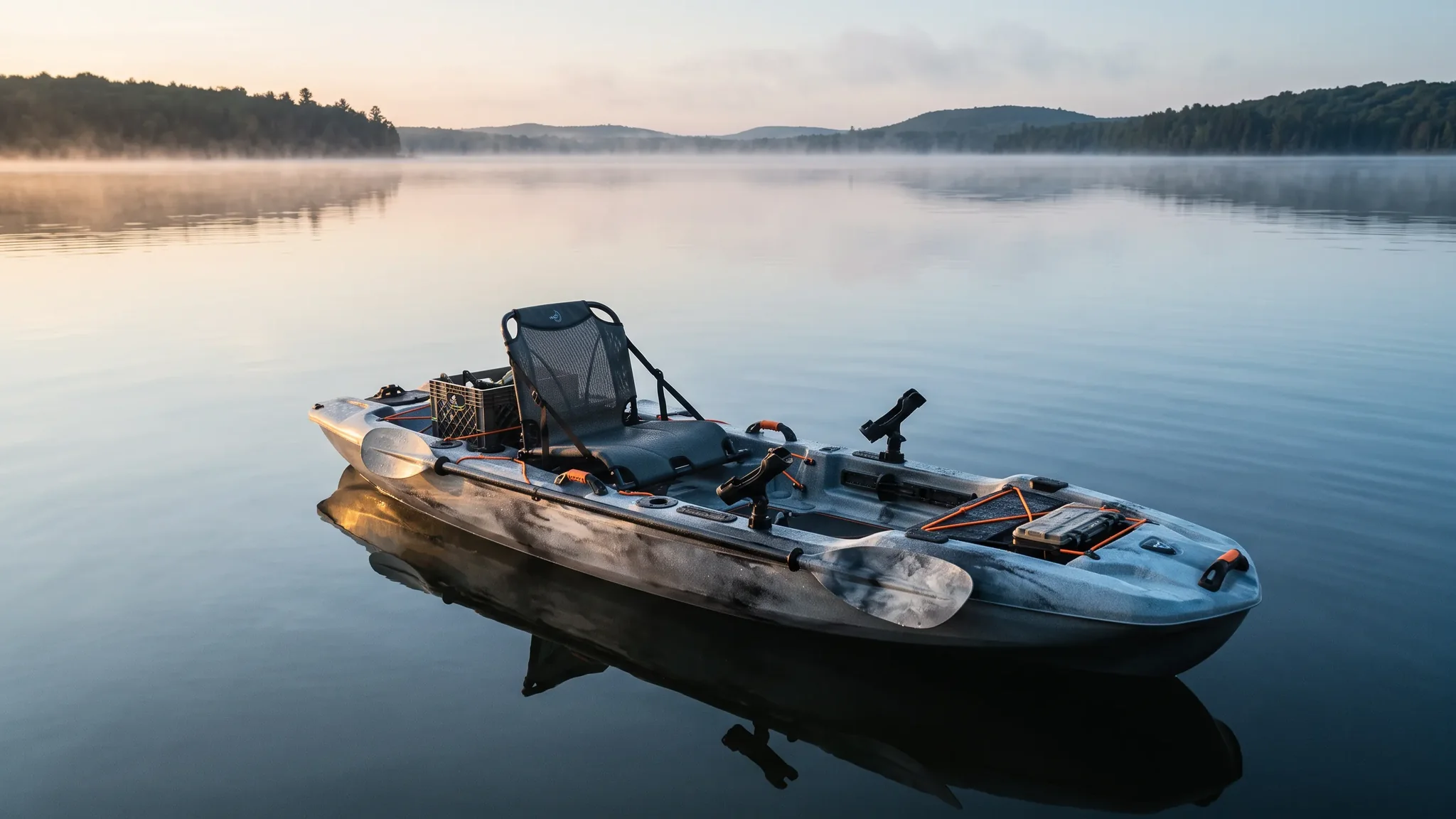
Before storage, before rod holders, before colour, a fishing kayak has to stay under you while you are busy with something else. You are casting, netting a fish, retying a knot, or reaching behind for a tackle tray. A boat that feels fine while you paddle across a calm bay can feel very different once your hands are full and your weight is shifting.
Stability comes from the shape of the hull and the width of the deck. Wider boats generally feel steadier standing still, and narrower ones generally glide better. The honest trade-off is that a very wide kayak is slower and heavier to carry, so the right choice depends on where you fish and how you get the boat to the water. The sections below cover stability first, then storage, then rod holders, then the pedal-or-paddle question, using the models we carry in the store.
Every boat in this guide is a sit-on-top. That is the usual design for fishing, because you can swing your legs around, reach your gear, and get back on the seat more easily than you can climb out of a closed cockpit. The numbers below come from the product pages on our site, so you can check each one before you buy.

Tunnel Hulls and Wide Decks Give You the Steadiest Platform
Two hull designs show up most in the fishing boats we stock. A tunnel hull has a channel along the underside that adds steadiness. A twin-arched multi-chine hull has two arches and several angled edges, which gives a steady ride and makes it easy to get in and out.
Pelican Catch Mode110
The Pelican Catch Mode110 ($1,199.95) is built on a tunnel hull, and Pelican describes it as very stable with great manoeuvrability. The deck is wide and flat, which gives you a large standing area and room for gear. It is 128 in (325 cm) long and 34.5 in (88 cm) wide, weighs 63 lb (28.6 kg), and has a maximum load of 375 lb (170.1 kg). The deck has an anti-slip carpet and a storage platform with bungee cords.
Our take: This is the boat for the angler who wants the roomiest deck we carry in this group. The trade-off is weight, so plan on a cart or a second set of hands for the walk to the water.
Pelican Catch Classic 100
The Pelican Catch Classic 100 ($899.95) is the lighter, smaller-angler version of the same idea. Its tunnel hull gives a stable platform with plenty of deck space, so you can stand up to cast and reel in fish. It is 120 in (304.8 cm) long and 34 in (86.36 cm) wide, weighs 57 lb (25.85 kg), and holds 350 lb (158.76 kg). Added flotation inside the hull meets or surpasses ABYC standards.
Pelican Sentinel 100 XP
The Pelican Sentinel 100 XP ($799.95) uses the twin-arched multi-chine hull, which Pelican says gives a stable, steady ride for casting and reeling in fish. It is 120 in (304.8 cm) long, 31 in (78.74 cm) wide, and weighs 44.5 lb (20.18 kg), with a 300 lb (136.08 kg) capacity. At that weight, one person can handle it more easily than the heavier decks above.
Perception Pescador Pro 10.0
The Perception Pescador Pro 10.0 ($1,249.95) is described as fast, stable, and designed to track straight in variable conditions. The shorter 10.0 model is easier to manoeuvre and to transport, which suits quiet water. It measures 10 ft 6 in long and 32 in wide, weighs 57 lb, and carries up to 325 lb.
Wilderness Systems Tarpon 105
The Wilderness Systems Tarpon 105 ($1,499.95) is described as equally at home on rivers, lakes, or oceans, with improved comfort, stability, speed, and paddler interface. It is 126 in (320 cm) long and 32 in (81 cm) wide, weighs 57.5 lb (26 kg), and has a 325 lb (147 kg) capacity.
A practical way to read all of these numbers: Compare width and weight together, then compare capacity to your own weight plus your gear. Capacity is the limit for people, rods, tackle, a cooler, and an anchor combined. Staying well under it keeps the boat steadier and drier.

Standing to Cast Is a Skill You Build in Shallow Water
Several of these decks are designed so you can stand up, but a wide deck is not a licence to stand in open water on day one. Try it first in calm, shallow water close to shore, in clothing you do not mind getting wet. Sit down before a boat wake reaches you, and keep your weight low and centred.
The Lifesaving Society is the Ontario branch of the national lifesaving organisation that works to prevent drowning. Its boating page says: “Stay seated! You can easily fall out of a small powerboat, canoe or kayak.” It also warns that “Cold water is deadlier than you think. Prepare for the shock of cold water by always wearing a life jacket.” With that warning in mind, we'd treat a lifejacket as part of the kayak, not as an extra.
A Lifejacket You Can Fish in Is Part of the Setup
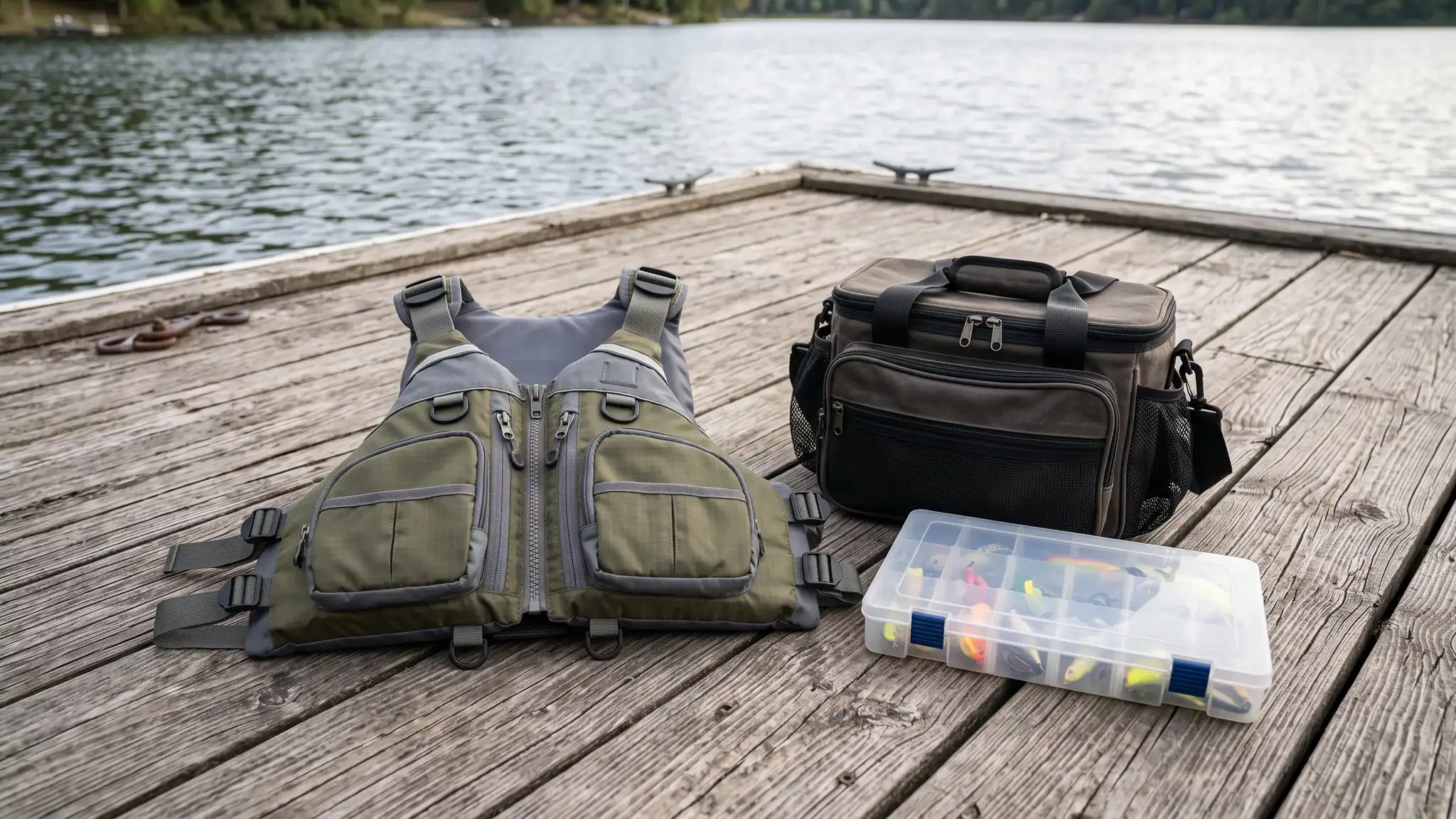
Transport Canada is the federal department responsible for marine safety. Its boating safety page states: “All boats must have enough properly fitted lifejackets or personal flotation devices for all people on board,” and says there is no good reason for a person not to wear one at all times. Its guide to choosing a lifejacket or PFD tells buyers to look for a label showing the device is approved by Transport Canada, the Canadian Coast Guard, or Fisheries and Oceans Canada.
For fishing, comfort decides whether you actually wear it. The NRS Chinook Fishing PFD ($199.95) is a fishing-specific vest. You can browse the rest of our lifejackets and PFDs, and bring your rod vest or layers when you come in so we can check the fit over what you will wear.
Storage Matters More Than Most Buyers Expect
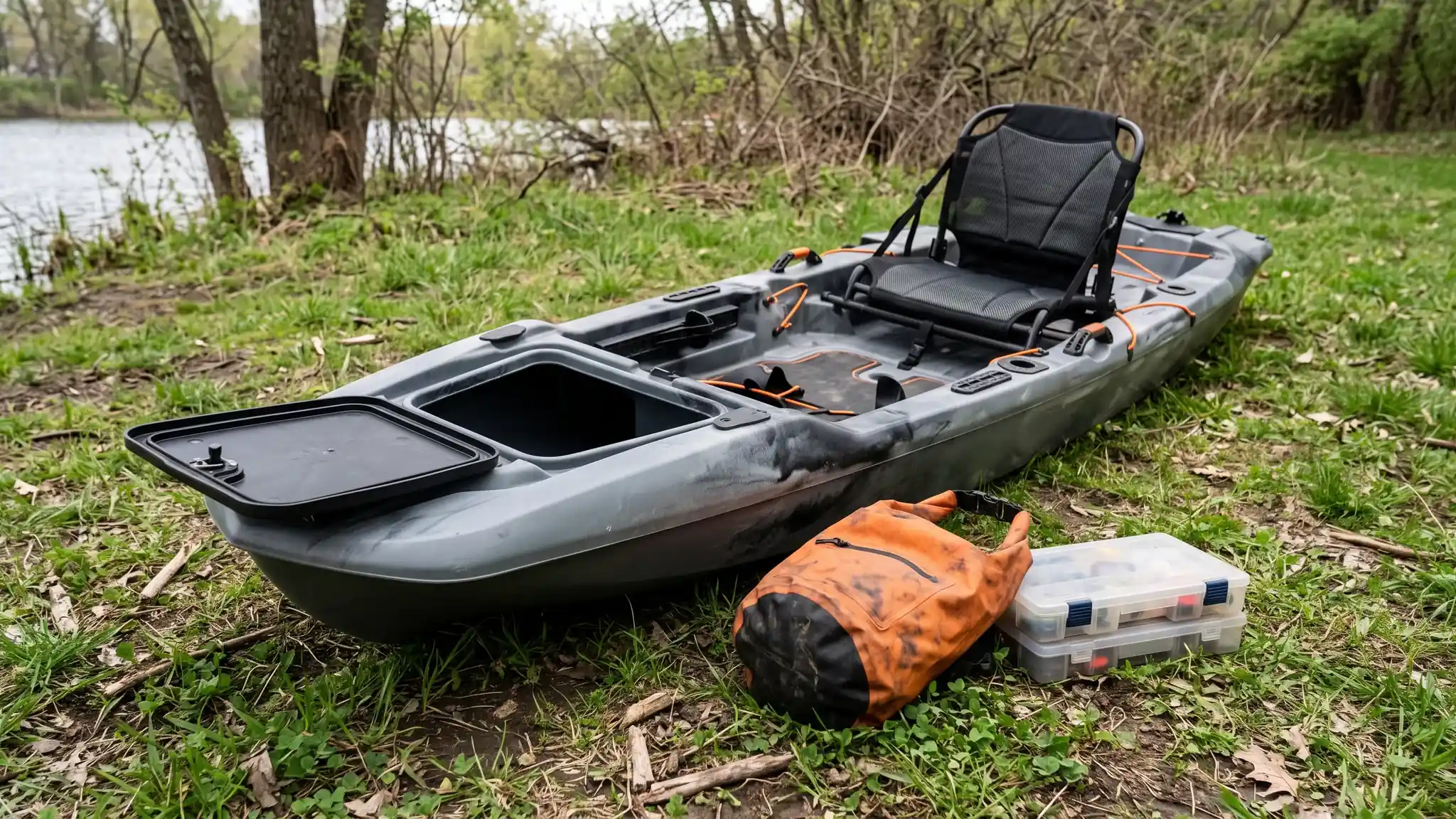
A fishing kayak carries more gear than a recreational one: tackle, pliers, a net, a drink, a dry bag, a camera, and often a crate. Where that gear lives changes how the boat feels, because loose gear shifts and heavy gear raised high makes the boat less steady. We'd aim for the heaviest items low and near the middle, and the things you reach for often within arm's length.
Here is how the storage differs across the boats we carry.
- Pelican Catch Classic 100: A front quick-lock hatch, a rear tank well with bungee cords, two flush-mount rod holders, two accessory eyelets, and two 4 in rigging tracks.
- Pelican Sentinel 100 XP: A front storage platform with bungee cords, 4 in rigging tracks, a smartphone holder, and compatibility with the Exocrate fishing crate bag.
- Pelican Sentinel 100X Angler: A centre console with moulded compartments, an ExoPak removable storage compartment with two vertical rod holders, a front platform with a deck cover, and a tank well with a mesh cover.
- Wilderness Systems Recon 120: The StowPro system with an extra-large gasketed hatch and bin, midship side pockets, tackle box recesses, and an under-seat storage area.
- Wilderness Systems Tarpon 105: A DryTec Case, an integrated dry box for valuables, plus configurable deck bungee rigging.
The Crate Bag for Tidy Tackle
The Pelican Fishing Bag Exocrate ($84.95) is the companion bag for the Sentinel 100 XP, per its product page. A crate-style bag keeps tackle in one place, so you can lift it out at the launch instead of unloading the boat piece by piece.
Rigging Kit for Your Own Mounting Points
The Pelican Kayak Mounting Kit ($24.95) has what you need to attach gear to a fishing kayak, canoe, or boat. It includes four nylon eyelets, eight stainless steel screws, and eight rubber covers for the screws. Use it with elastic bungee to hold paddles, rods, nets, and other items in place.
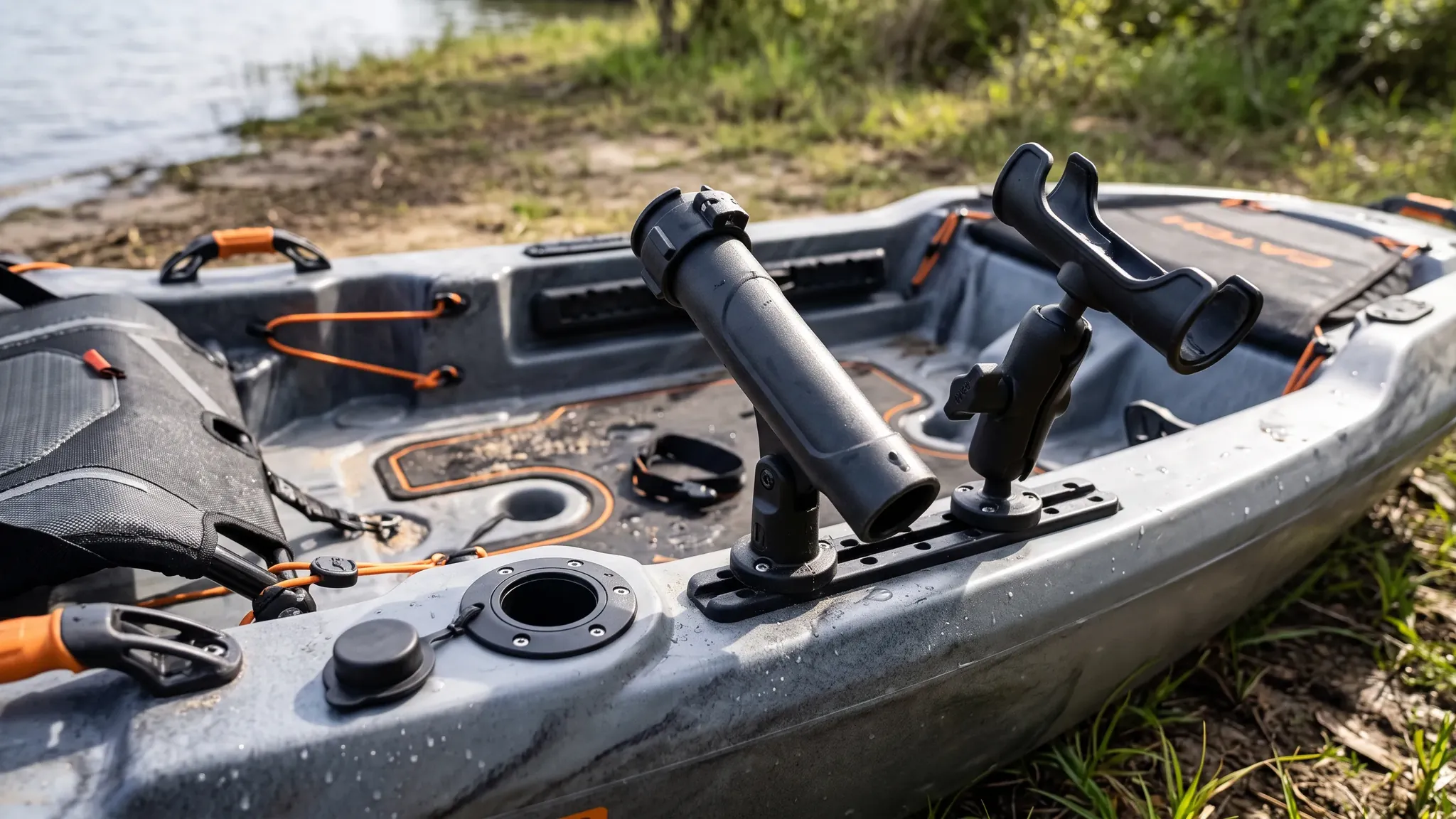
Rod Holders: Flush-Mount, Troughs, and the Ones You Add
Rod holders come in three styles, and the best boats mix them.
Flush-mount holders sit in the deck and hold a rod upright or at an angle. Both the Catch Classic 100 and the Sentinel 100 XP come with two. The Sentinel 100X Angler has two recessed rod holders plus two vertical holders in its removable ExoPak, and two clips for paddles or rods.
Rod troughs hold rods flat along the sides, out of the way when you paddle or cast. The Wilderness Systems Recon 120 ($1,899.95) has dual rod troughs that hold up to three 7 ft 6 in rods per side, with Silent Traction pads. That is the layout to look at if you carry several rods for different presentations.
Add-on holders let you turn an ordinary recreational kayak into a fishing kayak.
How to Add a Rod Holder
The Pelican Flush Mount Rod Holder ($14.95) is made from polypropylene with a watertight bottom to prevent leaks, and it fits any standard fishing rod. Installation needs a 6.35 cm (2.5 in) hole, and mounting hardware is included.
One note from the product page matters before you reach for a drill: Drilling or cutting new holes in your kayak voids the Limited Lifetime Warranty of the immediate surrounding area. If you want to keep the warranty whole, ask us about mounting options that do not need new holes. A rigging track or an existing eyelet may do the job.
Where to Put It
Mount a holder where you can reach the rod handle without leaning, and where a hooked fish cannot swing the rod across your lap. Behind you and to the side is a common spot, because the rod points away from your paddle stroke. Test the position on land with your seat set the way you fish.
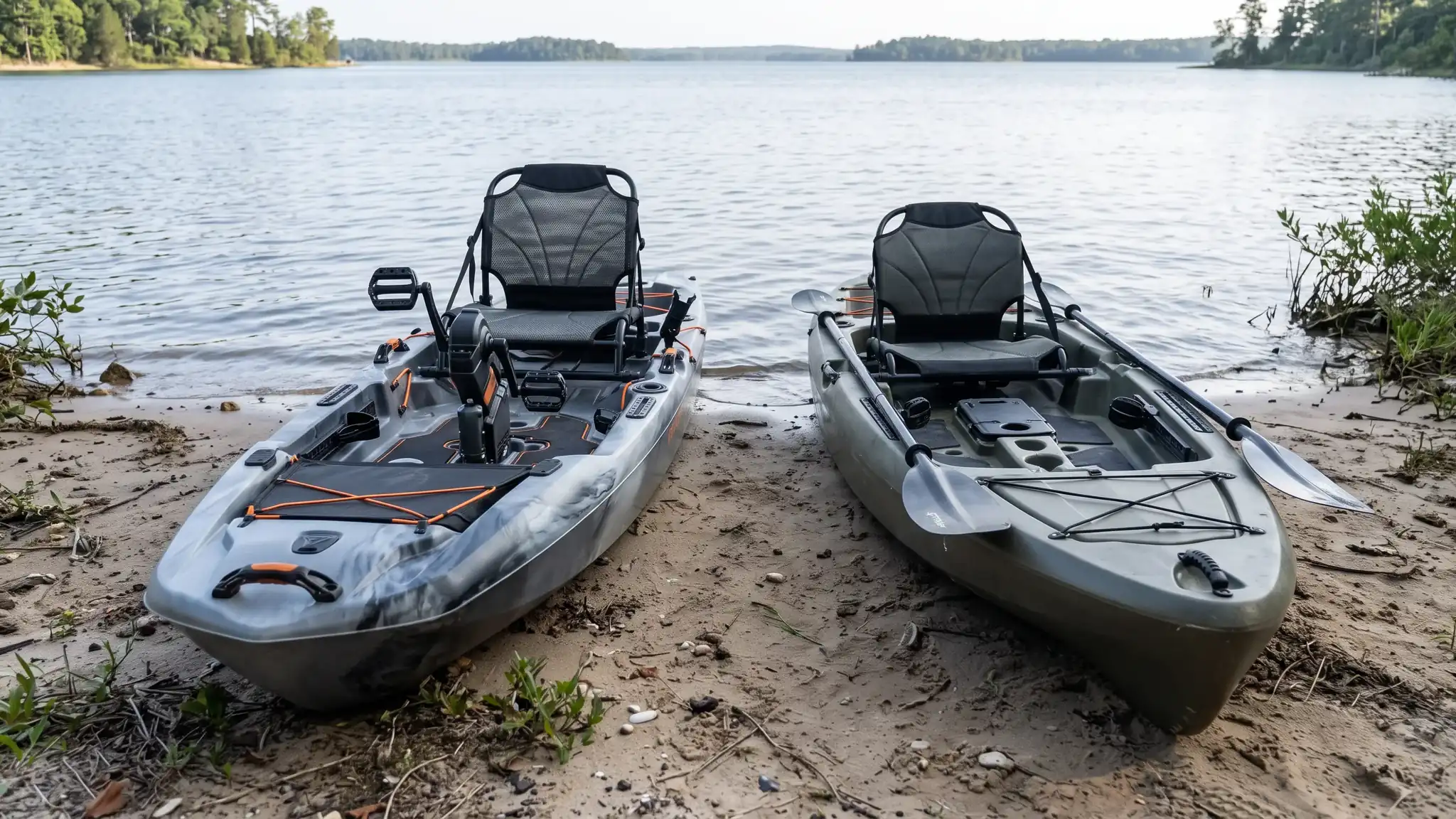
Pedal or Paddle: Decide by How Much You Move
This is the question anglers ask most. A paddle is simple, light, and cheap to run. A pedal drive frees your hands, so you can hold a rod while you reposition, which suits trolling or working a weed line. It adds cost and mechanical parts to look after.
The Wilderness Systems Recon 120 ($1,899.95) lets you choose. The page describes a fishing kayak you can rig your way, with the choice to paddle, pedal, or power. The model is Helix PD Pedal Drive-capable, but the pedal drive is purchased separately, and aftermarket motors can be mounted with a direct-to-boat stern interface. Its S.M.A.R.T. Hull Technology is tuned for paddling, pedalling, or motoring, and the deck is wide open for standing, casting, and hooksets.
The Catch Mode110 lists a recommended motor capacity of 2.5 HP (1.8 kW), if a small motor interests you. Check the rules for motors where you plan to fish before you buy.
Our take: If you fish small lakes and rivers and move a few hundred metres at a time, paddle first. A good paddle makes a big difference, and you can browse our fishing kayaks and the paddles in the kayak department together. If you troll or cover a lot of water, ask about the pedal-capable boats.
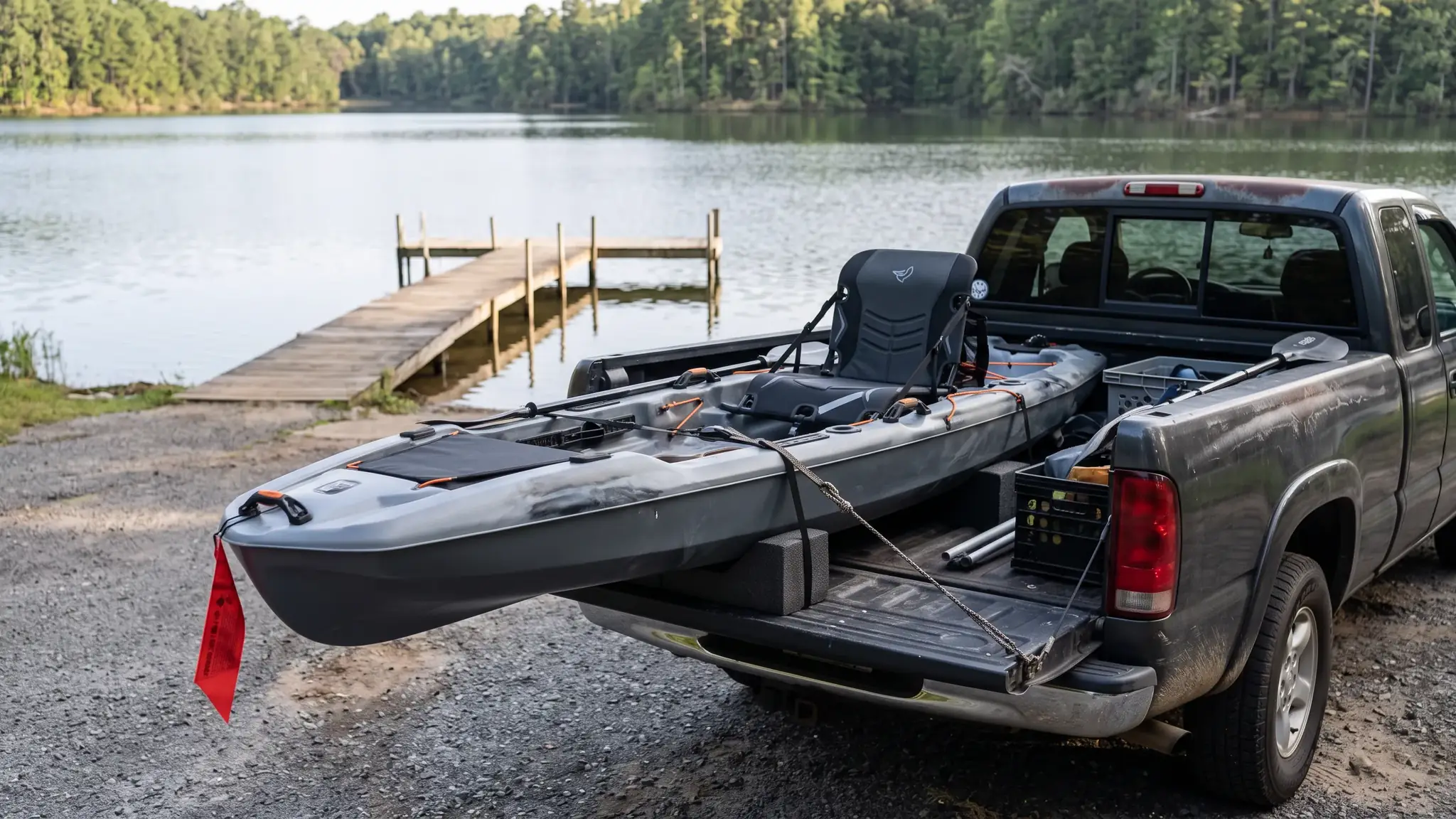
Getting It to the Water and Holding It in Place
Fishing kayaks are heavier and wider than recreational ones, and a boat of 57 to 63 lb is a lot to carry alone.
A Cart for the Walk to the Launch
The Wilderness Systems Heavy Duty Kayak Cart ($339.95) carries kayaks up to 330 lb. It has large balloon-style beach wheels that roll easily over sand, no scupper posts, so it does not stress your scupper holes, and an adjustable-width frame that stops the kayak from slipping sideways. It collapses, and the wheels come off for storage.
An Anchor for Holding a Spot
The Pelican 3 lb Folding Anchor Kit ($54.95) folds to 12.5 in x 5 in x 2.5 in, comes with 20 feet (6 m) of marine grade rope and a nylon storage bag, and suits sandy, weedy, muddy, or rocky bottoms. The page notes it is not for use in strong currents, so skip it on moving river water.
See more in our transportation gear, since a roof rack or carrier also decides how easily the boat gets to the lake.

How to Choose: A Short Checklist
- Where will you fish? Small lakes and rivers favour lighter boats like the Sentinel 100 XP. Open water and standing favour wider decks like the Catch Mode110.
- How will you get it there? Weigh the boat against your vehicle, your back, and whether you will buy a cart.
- How much will you carry? Add your weight to your gear and stay well under the listed capacity.
- How many rods? Two to three suits flush-mount holders, and more may suit troughs.
- Paddle or pedal? Decide before you buy, because a pedal-capable hull costs more.
A shop visit shortens this list. Sitting in the boat, checking how the seat feels, and lifting one end tell you more than a spec sheet can.
Questions
How stable is a fishing kayak?
Stability varies by hull and width. Tunnel hulls and wide decks, like the Pelican Catch Mode110 and Catch Classic 100, give the steadiest platforms for standing to cast. Narrower boats glide better but feel less steady when your hands are busy. Practise in calm shallow water, keep your weight low, and always wear a lifejacket.
How do I mount a rod holder?
The Pelican Flush Mount Rod Holder needs a 6.35 cm (2.5 in) hole, and its mounting hardware is included. Choose a spot you can reach without leaning, test the position on land, and note that drilling new holes voids the warranty around that area. Call us before you drill, and we can suggest alternatives.
Pedal or paddle?
Paddle if you fish small water and move short distances, since it is lighter, simpler, and cheaper. Choose pedal if you troll or cover a lot of water and want your hands free. The Wilderness Systems Recon 120 is pedal-drive-capable, but the drive is sold separately, so budget for it.
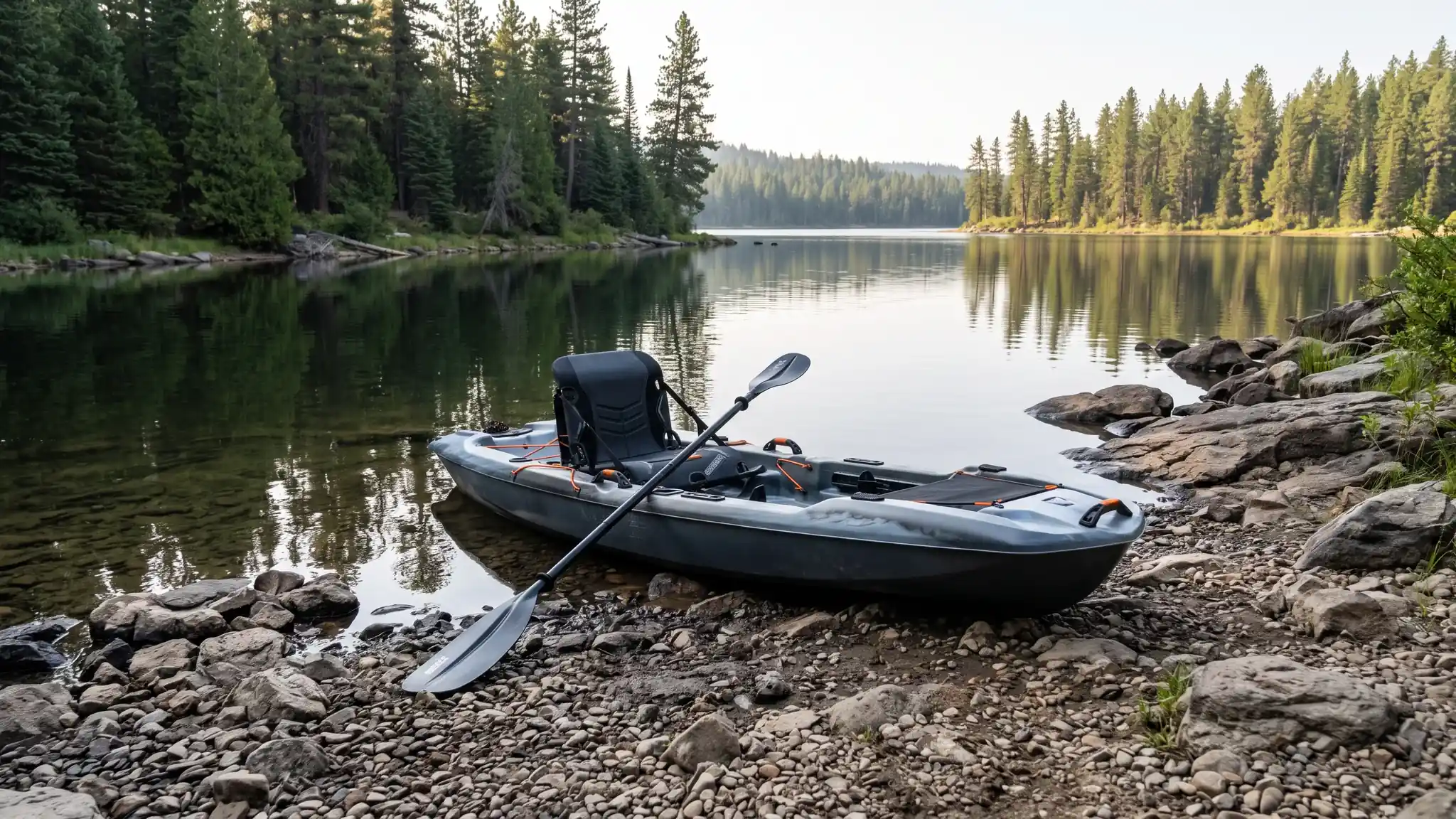
Come See the Fishing Kayaks at Our Store in Sault Ste. Marie
The easiest way to pick a fishing kayak is to sit in a few. Visit Great Lakes Outfitters at 162 Old Garden River Rd, Sault Ste. Marie, ON P6B 5A6, or call us at (705) 253-2361. Kayaks ship by quote, so call for a price to your door, or order online and pick up at the store.
Talk to us about it
- 162 Old Garden River Rd, Sault Ste. Marie, ON P6B 5A6
- (705) 253-2361
- Open today 10 a.m. to 6 p.m.
- Send us a message
References
About the author
Kevin Coombs
Sales Representative
I am a sales representative at Great Lakes Outfitters. I have been here five years, since I retired after more than 33 years as a forester.
More from Kevin Coombs



 English (Canada)
 Français du Canada